Partisan Life with Col. John S. Mosby: by Major John Scott, of Fauquier, late C.S.A. New York: Harper & Brothers, Publishers, Franklin Square, 1867
Major John Scott, 43rd Battalion Virginia Cavalry, Mosby’s Rangers
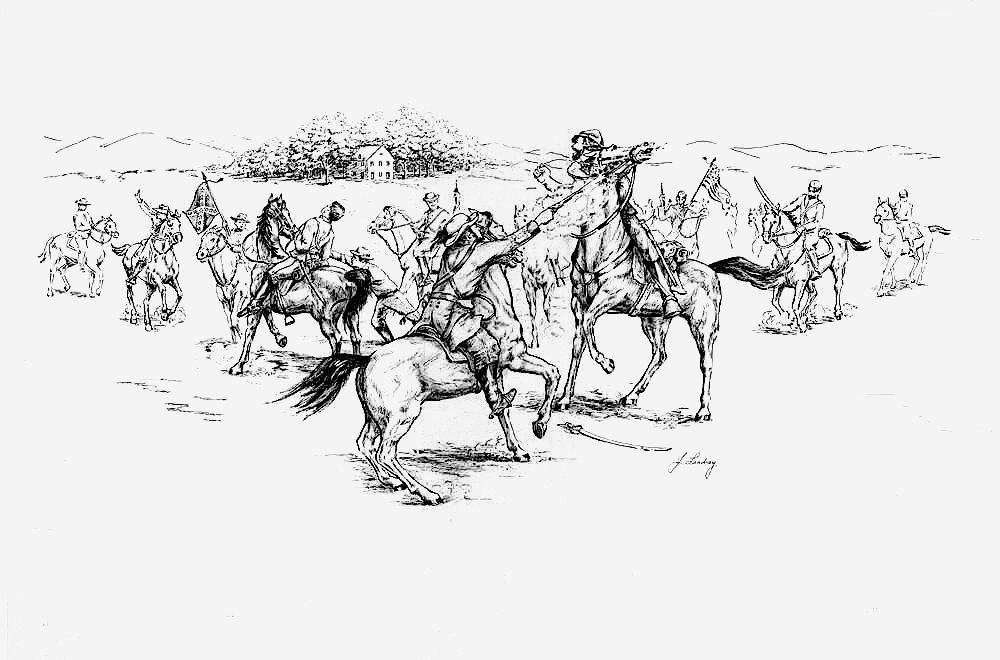
Having discovered that the Federals had gone toward Aldie, Mosby, instead of following their track, took the road leading to Ball’s Mills, from which point he would be able to throw himself in their front on their return to the camp at Falls Church, thus pursuing the same military policy which had resulted in the success at Anker’s Shop. Leaving the command in charge of Captain Chapman, the next morning he took with him Willie Mosby, Wat Bowie, Bush Underwood, and a few others, and went on a scout for the purpose of ascertaining the whereabouts of Major Forbes, who, in the meantime, had come from Aldie to Mount Zion Church, two miles below, on the Little River Turnpike. Soon the scouting-party encountered a detachment of the enemy, before whom they retreated to the command at the Mills, where Mosby, supposing that he would soon be attacked by Major Forbes’s entire force, posted himself in an advantageous position to receive the anticipated charge. But his expectations were not realized, and, finding that no attack was intended, Colonel Mosby marched to a point on the Little River Turnpike, two miles below Mount Zion, in the hope that Major Forbes would pass his position on his return to Falls Church. But, after waiting in vain for the space of two hours for the fulfillment of this expectation, he determined to seek his antagonist, and fight him in the open field. When he came in sight of Mount Zion Church, he found the enemy drawn up on the left of the road, in an open field, which had a gradual slope to the turnpike, with one squadron posted in advance of the other. Mosby’s dispositions for attack were then made as follows. A body of sharp-shooters, under command of Harry Hatcher, was sent forward to occupy a skirt of woods on his left, while he stationed the Napoleon in the road, supported by Company “D,” commanded by Lieutenant Glasscock, and disposed the rest of the command in a position from which they could charge the enemy.
The fight was opened by an ineffectual shot from the Napoleon, followed by an impetuous charge, led by Mosby. Major Forbes’s advance squadron for a time stood firm, but, finding itself overpowered, and attacked in front and flank, wheeled and fell back upon the squadron in the rear. This movement soon became a retreat, in which the rest of the command united. About six hundred yards in their rear, the Federals were checked by a high fence, and here a party of twenty-five men turned upon their pursuers, and fought with determined but useless valor, in a hand-to-hand combat, for in a little while half of this gallant band were either killed, wounded, or dragged to the ground by their wounded horses. As soon as the fence gave way the retreat became a rout; but at a point farther on in the direction of Sudley Mills, another party of the enemy, numbering about fifteen, rallied and drove back a few of the pursuers; but they were soon re-enforced, and this second party, like their comrades, were forced to seek safety in flight.
Mosby, with Johnny Edmunds, continued the pursuit to Sudley Mills, a distance of ten miles from Mount Zion Church, where the fight began, from which point they returned, driving before them about fifteen loose horses.
Mosby’s loss in the engagement was Henry Smallwood mortally wounded, Bob Walker, Tom Richards, and Tom Lake severely wounded, and Willie Martin badly bruised by blows with a carbine. The enemy lost twenty killed and mortally wounded, twenty-five badly wounded, sixty taken prisoners, and ninety horses, with their equipments.
As soon as it was reported that Major Forbes, well known as a successful raider, was in command of the opposing force, several of the Rangers expressed their determination to be his captor. But fortune favored Tom Richards, who, after a fierce hand-to-hand conflict, in which he received a dangerous wound, succeeded in making the Federal officer his prisoner. The next day the booty was divided at Piedmont, and the prisoners sent to Richmond. Thus terminated one of Mosby’s most brilliant expeditions, for in the period of five days he had crossed the Potomac, captured the Point of Rocks and dispersed its garrison, and then had turned upon an unexpected adversary in superior force, and had routed, pursued, and captured him.[1]
_____________________________________________________________________________________
Mosby’s Rangers: A Record of the Operations of the Forty-Third Battalion Virginia Cavalry, from its Organization to the Surrender, from the Diary of a Private, Supplemented and Verified with Official Reports of Federal Officers and also of Mosby; with Personal Reminiscences, Sketches of Skirmishes, Battles and Bivouacs, Dashing Raids and Daring Adventures, Scenes and Incidents in the History of Mosby’s Command.
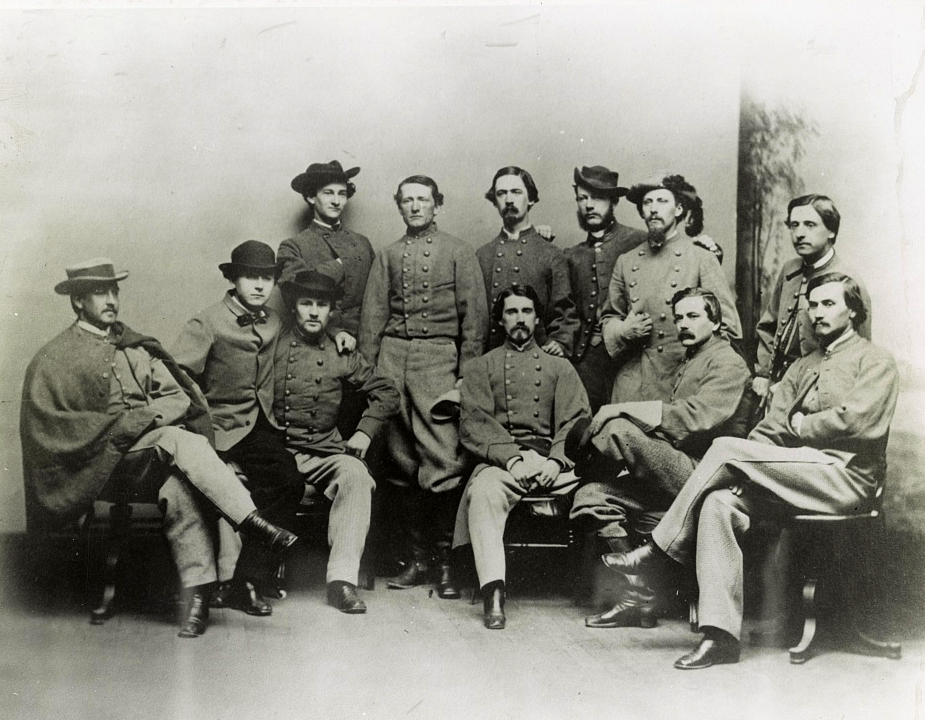
In the evening we moved off in the direction of Leesburg, within a few miles of which place the command halted, and after feeding our horses, unsaddled and prepared to pass the night. A very short time, however, had elapsed when Lieutenant Hatcher, John Thomas and C. Albert Fox, who had gone to Leesburg, returned with the intelligence that a large force of Federal cavalry was at that place; that they had told some of the citizens that Mosby was in Maryland and they had cut off his retreat — that they had him just where they wanted him. Orders were given to saddle up, and we moved off, passing around Leesburg and halting near Waterford. Carlisle and Puryear were sent as scouts to Leesburg. On their return they reported the force there to be portions of the Second Massachusetts and Thirteenth New York Cavalry, under Major Forbes — “Colonel Lowell’s fighting Major,” as he was called — 250 in number. We then had only about 175 men, as many had left for home during the day.
On the morning of the 6th we marched to Leesburg. Forbes had left, going towards Oatland. Mosby then pressed on, thinking to cut them off at Ball’s Mill, on Goose Creek, but on reaching the ford, found that they had already crossed and gone in the direction of Mount Zion on the Aldie turnpike. Mosby came out on the pike near the toll-gate below Mount Zion. The Federals had been feeding their horses opposite Skinner’s house below Mount Zion, but were preparing to move on. Our carbineers, under Lieutenant Hatcher, advanced and opened fire on them from a body of woods, as they came out on the pike. The gun was then brought up and a shell fired, which did no other damage than to give them a fright. They formed in a field near the house and we charged them in front and on their flank. Unable to stand the shock, they broke and ran some distance, but rallied and formed again behind a fence. They rallied and attempted to form three times, but Mosby pressed on and drove them in disorder each time. Some of our men followed the fugitives to Sudley, and two were killed near that place.
Major Forbes, who was in command, fought gallantly, and was always in the thickest of the fight, encouraging and endeavoring to rally his men. Thomas W. T. Richards, brother of Capt. A. E. Richards, at last singled him out, and a fierce hand-to-hand struggle took place between them. Forbes made a savage cut with his sabre at Richards, inflicting a severe wound on his shoulder, but Richards finally forced him to surrender. The Federals were all well armed and fought desperately.
Mosby had 7 men wounded: Henry Smallwood, mortally; William Davis, Thomas Lake, Hugh T. Waters, Frank M. Woolf, Thomas W. T. Richards and Robert S. Walker. Forbes lost 17 killed, about 40 wounded — 12 or 15 mortally, and 57 prisoners. Over 100 horses were captured. A number of horses were wounded, and 12 were left dead on the field, which presented a sad sight. The ground was strewn with guns, pistols, blankets and equipments of all kinds; dead and wounded were lying around: horses, wounded and maddened with pain and fright, dashed wildly over the battleground, while others lay trembling, or rearing and falling, unable to stand. Skinner’s house was used as a hospital, and Doctors Dunn and Sowers were busily engaged in attending to the wounded. We remained until near midnight, when we moved off to Middleburg.
Colonel Lowell came up to Mount Zion the day after the fight with a force and buried the dead Federals and carried off the wounded. Four dead soldiers, however, were found several days after the fight and were buried by the citizens.[2]
_____________________________________________________________________________________
Life and letters of Charles Russell Lowell, captain Sixth United States Cavalry, colonel Second Massachusetts Cavalry, brigadier-general United States Volunteers
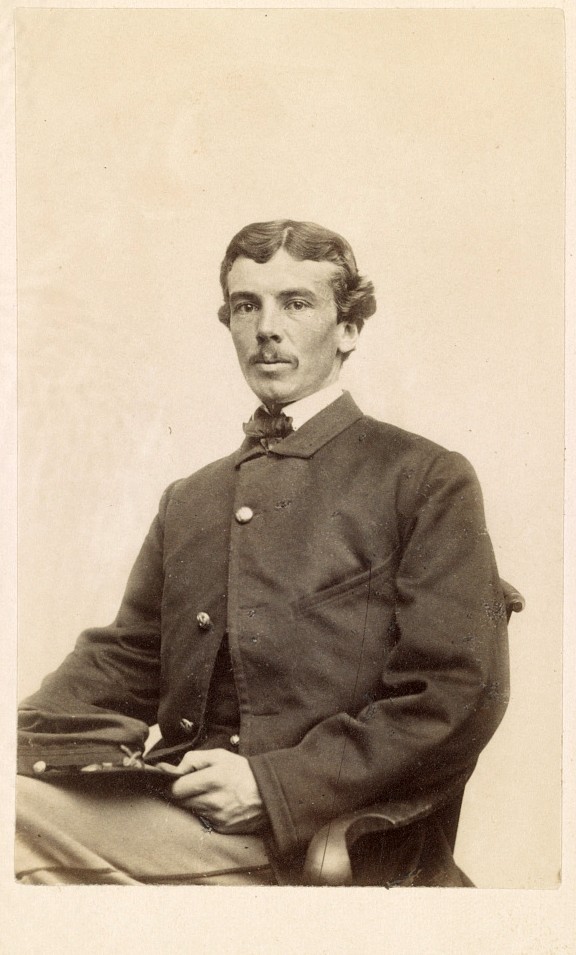
July 6. The regiment suffered another severe disaster, largely due, like that of Captain Read, to the party’s being ordered to remain out for a considerable time, visiting certain towns, which allowed time for the hostile inhabitants to send word to Mosby of the exact number of men in the command, and to direct him where to find them. Colonel Lowell reported that he had sent Major Forbes, with one hundred and fifty men, on a three-days scout towards the gaps in the Blue Ridge, with orders to visit Leesburg on two days. Major Forbes found all quiet, and on the second day learned that Mosby was absent on a raid north of the Potomac; next day he returned to Leesburg, found all quiet, and, in accordance with his orders, began his return march towards Vienna. Meanwhile Mosby, returning from his raid, had been notified of the strength and probable whereabouts of the command, and with a force of two hundred men or more, and a gun, came suddenly upon them at Zion’s Church, near Aldie, and opened fire with his gun. The result was a victory for the Partisan force, who killed forty men of the Second Massachusetts and Thirteenth New York Cavalry, wounded many, and took about one hundred horses.
From the accounts of officers there engaged, I add the following. While Major Forbes was feeding and resting his command in a field on the edge of some woods, his vedettes brought in word of Mosby’ s force being close at hand. He had hastily mounted and formed his squadrons, when the large guerrilla force appeared before them and sent a shell among them. This was an absolutely novel experience to men and horses, who till then had never faced artillery, and made them very unsteady, especially the new squadrons. The obvious and necessary move was an instant charge with the sabre, but a stiff fence before them rendered this impracticable without moving the command. The first squadron behaved well as long as they faced the enemy, but the moment Major Forbes gave the order “Fours right,” to shift to a possible charging ground, the spell was broken, and the men began to break away from the rear. Mosby’s men, who had taken down a panel or two of the fence meantime, under cover of the gun, “got the yell” on their opponents, rushed in on their flank with the revolver, and, in spite of efforts of their officers to rally them, the greater part of the command fled. Many were shot in close pursuit. Major Forbes, with a few of the best soldiers, charged and fought gallantly, but these were overpowered or killed. The major ran his sabre into the shoulder of a Captain Richards, and it flew from his hands. At that moment Colonel Mosby shot at him at close range, but the ball fortunately was stopped by the head of his horse thrown up at that minute. The horse fell dead, pinioning Major Forbes to the ground, and helpless, with half a dozen pistols at his temples, he had to surrender. Lieutenant Amory was taken with him. They were at once robbed of part of their clothing and their boots, but when their captors under[1]took to search Major Forbes’ s pockets, he is reported to have said they might have his brains, but he meant to keep what money he had, and ordered them to carry him to their officers. Some one of these prevented any further outrage, but the officers had to walk “stocking foot” on the first day’s march towards a Southern prison.
Years after, Colonel Mosby, in a newspaper article, said: “One of the regiments I most frequently encountered was from about Boston, the Second Massachusetts Cavalry, Colonel Lowell. I once met a detachment of it under command of a Major Forbes of Boston, and although our encounter resulted in his overthrow, he bore himself with conspicuous gallantry, and I saw him wound one of my best men with his sabre.” The day after the fight. Rev. Charles A. Humphrey the chaplain of the Second Cavalry, who was with the expedition and had bravely stayed by a mortally wounded private until his death, was, while burying the body, in spite of his cloth, captured and robbed by a young guerrilla, and sent to join Forbes and Amory in prison.[3]
On the evening of July 4 Colonel Lowell sent me out to remain three day in the country between Aldie and Leesburg, to report any movement eastward from the Blue Ridge of General Early’s column. My force was 100 of the 2nd Massachusetts Cavalry and 50 of the 13th New York Cavalry – with five officers and a scout, 157 all told, as also counted by a farmer and reported to Mosby, so one of his men informed me.
One the evening of the 6th Mosby, who had been lying in wait for us at Balls Mills, came across the Little River ‘pike and moved to attack us, not, however, knowing our exact position, near Skinner’s house a mile east of Aldie. Our pickets saw some of his men first, and we moved out and formed in a field on the south of the road. Unexpectedly we found two fences between us and the woods where Mosby formed.
He opened with his field piece, which shook some recruits I had, and in trying to move round these fences and reach open ground some of our men became so unsteady that their officers could not control them. A charge was ordered by Mosby, and the men broke and could not be stopped. The pursuit was pressed, and the retreat was a rout. Captain Stone of the 2nd was mortally and Captain Schuyler of the 13th badly wounded. I think only one officer reached camp, Lieutenants Armory and Burns and myself being taken prisoners in the field where we tried to re-form the men. I cannot give you the particulars of the losses, but we had about twelve killed and a number wounded, and about thirty-five enlisted prisoners, I think. Mosby’s loss was not over two or three killed and six wounded, if I am right. Mosby’s men variously gave their number as 200 to 250. I think his four companies were all there. Captain Stone was wounded in a gallant attempt to rally some of his company near a church in the woods not far from where the action began.
[1] Partisan Life with Col. John S. Mosby: by Major John Scott, of Fauquier, late C.S.A. New York: Harper & Brothers, Publishers, Franklin Square, 1867. Pages 246-49
[2] Mosby’s Rangers: A Record of the Operations of the Forty-third Battalion Virginia Cavalry, from its Organization to the Surrender, from the Diary of a Private, supplemented and verified with Official Reports, etc. By JAMES J. WILLIAMSON, of Company A. (New York: Ralph B. Kenyon. 1896.) Pages 112-13
[3] Life and letters of Charles Russell Lowell, captain Sixth United States Cavalry, colonel Second Massachusetts Cavalry, brigadier-general United States Volunteers. By Edward Waldo Emerson. Houghton, Mifflin & Co., Boston & New York. Pages 452-55
 Mairi & Dave's Gallivant Through Virginia and About