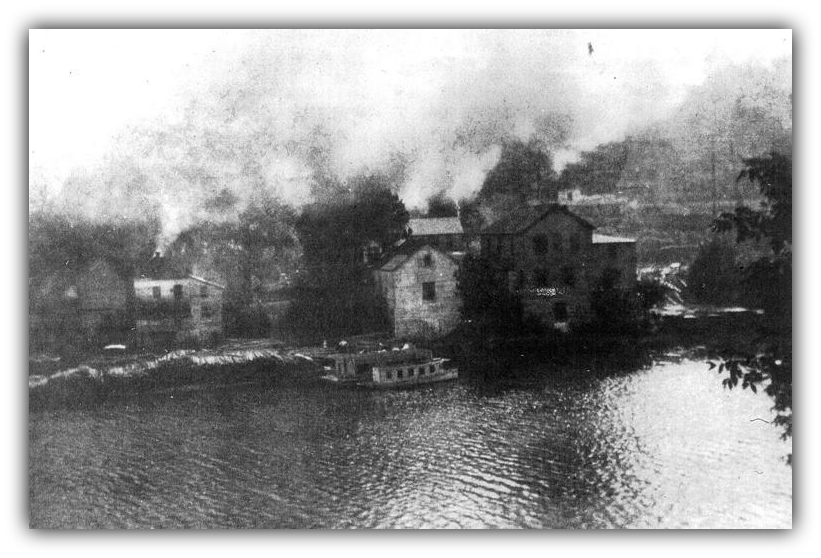
We never have to gallivant far when we gallivant to Occoquan since we lived for ten years about two half blocks from the town limits and live about ten minutes away now. This is one our favorite spots to dine, to wander the streets of and shop the shops. I recently came across the above photograph. This got me thinking about another blog on Occoquan we wrote, and the subject of the fire came up. We have access to a large data base of newspapers going back beyond the Civil War period. There are two transcribed newspaper articles. The first is from the Evening Star of Washington, DC and the second from the Alexandria Gazette. The Gazette was added because of the details of “Alexandria’s new chemical automobile fire engine”. We think you will find these newspaper articles as fascinating as we did.
Historic Occoquan, VA, Prosperity, War and a Devastating Fire

OCCOQUAN, Va., August 26. – Between forty and fifty residents of Occoquan last night slept in the homes of friends or in the Odd Fellows’ Hall here as the result of a disastrous fire which swept away their homes and other property in the afternoon. The loss is between $40,000 and $50,000.
The fire originated about 2:30 o’clock from an unknown cause in the rear part of the home of Mrs. J. Hood Weedon on Mills street, the principal thoroughfare of this little town. By the time the flames were discovered by Mrs. Weedon, who had gone to the front porch of her home a few minutes before, they had gained considerable headway. The cries of Mrs. Weedon were heard by neighbors and soon an alarm was sounding throughout the village calling for help. A bucket brigade was formed. Water was taken from nearby wells and also from Occoquan creek, on which the town lies. The fire-fighters, however, were unable to do much good against the flames, which were fanned by a strong wind. Although Mrs. Weedon’s home, formerly the Alton Hotel, was built of brick, it was soon a mass of ruins.
Bank Building Burned.
With the outbreak of the fire James Barbee, cashier of the Bank of Occoquan, which adjoined the hotel, placed all of the money and papers in the large vault, and then went to join the fire fighters in their efforts to keep the fire from spreading to the bank building. Their efforts, however, were without avail, as the roof of the building was soon a mass of flames, and in a few minutes the interior of the institution was wiped out. It was said the money and papers in the vault were believed to be safe.
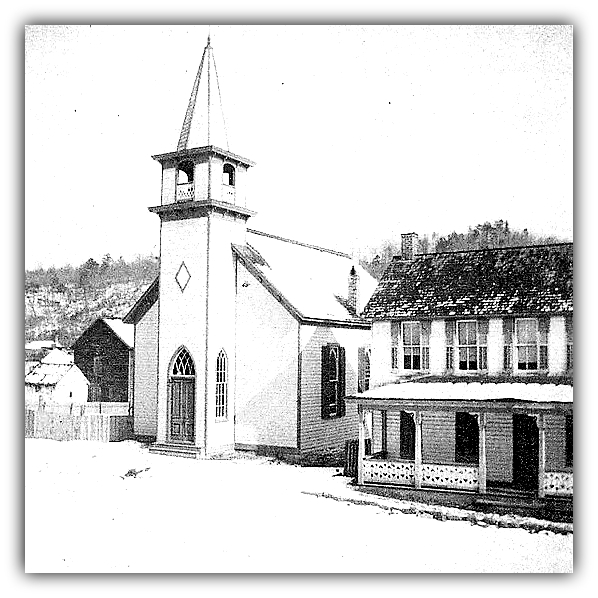
The fire spread northward, and soon the general merchandise store and dwelling of W.W. Lynn went up in smoke. About the time this building caught fire Ralph Whitaker, son of W.H. Whitaker, superintendent of the District workhouse, across the creek, heard of the fire and dispatched the chemical engine stationed at the institution to the scene. For a time the volunteer firemen used the chemicals to advantage, but the wind shifted the flames toward the rear, and soon the dwellings and the Occoquan M.E. Church South were on fire.
Prisoners Render Aid.
In connection with the sending of the fire apparatus to Occoquan, Mr. Whitaker, with several guard, took seventy-five prisoners for the workhouse to the scene, and they worked diligently in carrying furniture, clothing and other property from threatened buildings. They also formed bucket brigades.
After the flames had destroyed the Lynn store and residence, they burned through the residence of Oliver Underwood and then jumped across an alleyway and destroyed the home of Wade H. Hammill.
Calls for helped were telephoned to nearby towns, and an effort was made to reach Alexandria by telephone to ask that fire apparatus be sent. Communication, however, could not be had with that place, and a telephone message was sent to the Washington Star asking that the fire department of Alexandria be notified. It was on the message sent by The Star that the big motor fire engine of that town was dispatched to the scene. The run of fifteen miles over a road which is bad in spots was made in forty-three minutes.
When the fire apparatus, in charge of Capt. Henry Beach, pulled into the town, he said later, it looked as if the entire place would soon go up in flames. The motor engine backed up to Occoquan creek and residents assisted the firemen in carrying the hose several hundred yards and soon water was being thrown, but not before the fire had jumped across the street and destroyed the plant of the Viadex Manufacturing Company, a dwelling occupied by Walter Neal, and the ice house of Dr. Frank Hornbaker.
Aided by Shifting Wind.
It was a short time later that the firemen succeeded in checking the fire in the northward spread. The wind, which had shifted, also aided the firemen, as the flames were kept away from a number of large buildings.
Telephone wires and brick walls of some of the buildings began to fall while the firemen were working nearby and for a time menaced them. When it was seen that there was but little chance of saving the church and property on Commerce street articles of furniture were removed to places of safety.
It was not until the church and several residences on Commerce street had been burned down that the fire was actually under control. It was about 6 o’clock last evening before the danger of the flames spreading was passed. The firemen and residents, as bucket brigades, worked long into the night putting out the smoldering flames in the burned buildings.
No one was injured during the fire, although, after the flames had wiped out the places on Mill street, several venturous ones had narrow escapes from falling walls. As soon as it was seen that the fire was under control preparations were being made by the more fortunate residents to care for those whose property had been destroyed. The Odd Fellows’ Hall was thrown open and several families spent the night there, while others were taken into the homes of friends.
Origin of Fire Unknown
Mrs. Weedon, in whose home the fire originated, is the mother of Virginia Weedon, a patient at a Washington hospital, who was scalped recently when her hair became entangled in the shaft of a motor boat after she had been recued from drowning. A report was spread that the fire started from a gasoline stove, but this was denied by Mrs. Weedon, who said she had not been using such a stove. Persons who reached the scene shortly after the fire had been discovered expressed their opinion that the flames were of spontaneous combustion, as they appeared to have started under the flooring in the rear of the house.
C.A.L.

Making a record run to historic Occoquan, 17 miles south of this city, at the head of Occoquan Bay, Alexandria’s new chemical automobile fire engine stayed the progress of the huge conflagration which raged in the little Virginia village yesterday afternoon and saved it from entire destruction. Wires were kept hot yesterday afternoon from Occoquan to Washington and this city asking for help in controlling the fire, and the Alexandria engine was the only one to answer the call.
Word for aid was received about 4:30 o’clock here yesterday and the chemical engine was on the scene of fire 45 minutes later.
Immediately upon arrival of the automobile engine, the fire was put under control by the half a dozen or so Alexandria laddies who left with the engine, the first work of salvage accomplished by the local fire fighters being the saving of Janney’s flour mill from destruction. Directly after this the flames were put under control, and the Alexandria engine, with its speed and easy operation, and the several firemen of this city who operated it, with their swiftness and all-around capability, were praised and lauded to the skies last night by the residents of the little town after the flames had been extinguished.
Total destruction resulted to only about eight buildings, although first advices last night were to the effect that thirty had been wiped out. Many more, however, were badly damaged. The entire loss was about $50,000, according to a statement early this morning by one of Occoquan’s prominent citizens to a representative of the Gazette, but most of this is covered by insurance.
The heaviest loss was suffered by W.S. Lynn, whose general merchandise store, and contents, valued at about $5,000, was included in the toll reaped by the inexorable flames. Besides this other buildings totally destroyed included the Methodist Episcopal Church, the building of the Bank of Occoquan, the Oliver Underwood property, occupied by F.B. Allen, the property owned by W.H. Hammill, the building occupied by the Viadex Manufacturing Company, the residence of Mrs. J. Hood Weedon, and several other brick and frame residences.
It is stated that a house owned in Occoquan by Mrs. W.M. Reardon, of this city, was destroyed or irreparably damaged, but communication between Occoquan and the Gazette brought no confirmation of this.
The report that Mrs. Reardon’s old home was burned to the ground was confirmed later today, however. The house owned by Mrs. Reardon, and that of Dr. John S. Powell, were landmarks of the historic old village.
The fire started in the residence of Mrs. Weedon, in the central portion of the town, thought to have been caused by the overturning of an oil stove, although Mrs. Weedon was absent at the time. Last week, according to an announcement in the Gazette, Mrs. Weedon’s daughter, Miss Virginia Weedon, after being rescued from drowning in Occoquan Bay, had her scalp torn off by the propellor shaft of a motorboat conveying her home.
As announced above, the first work of the Alexandria engine was extinguishing of the blazes started in the mill and store of Tyson Janney, which had been partially under control by the emergency fire department, the “bucket brigade,” of the District Workhouse.
Following were the fire fighters who made the trip from Alexandria with the chemical engine: Chief Robert E. Gronau, Raymond Catts, operator of the engine, John L. Peed, H.A. Simpson, John Clapdore, driver of the Relief truck. They state that they returned last night about 10:45 o’clock.
 Mairi & Dave's Gallivant Through Virginia and About