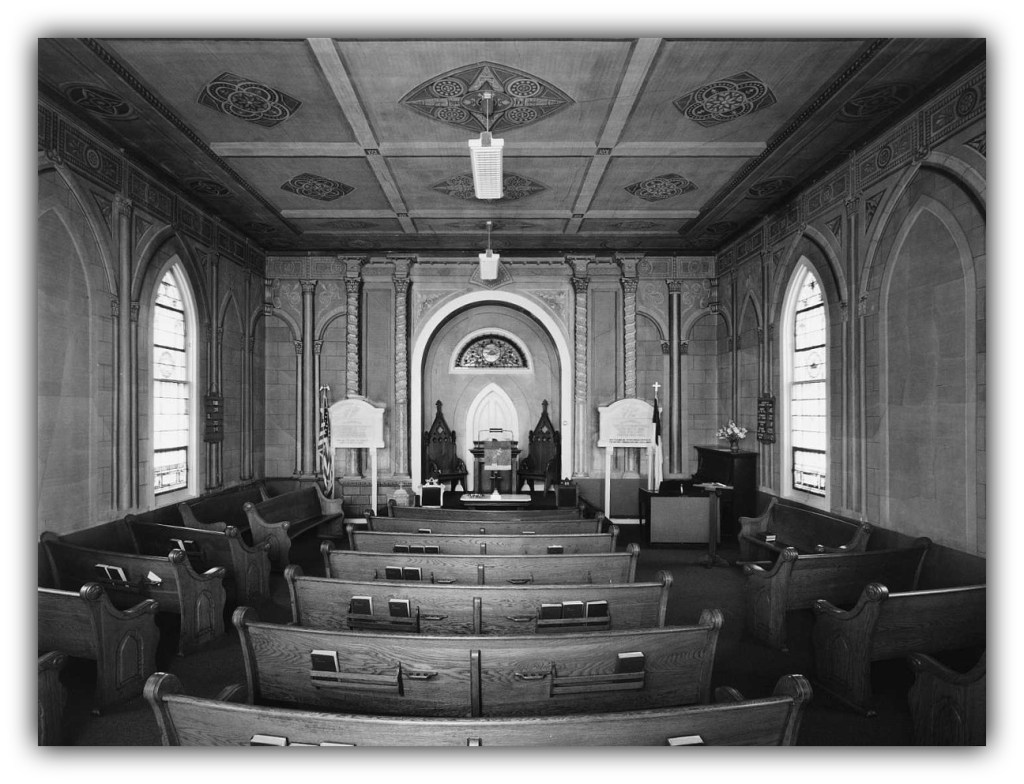
From the Home Page of Mitchell’s Presbyterian Church
Mitchells Presbyterian Church began around 1844 in Orange County and was known as the Rapid Ann Presbyterian Chapel. On October 18, 1867, the congregation was granted permission by the Presbytery of Rappahannock to organize as Rapidan Church. Due to the rising of the Rapidan River, the congregation from Culpeper County decided to relocate to “this side of the river.” The present sanctuary was dedicated in 1879 and the name was changed to Mitchells Presbyterian Church in 1888.
In the years between 1892-1899, Joseph Oddenino was commissioned by the church to paint the interior walls. He used the technique of trompe-l’oeil (from the French meaning “deceive the eye”). The church is a registered landmark on both the Virginia Historic Landmarks Register and the National Register of Historic Places.
After the death of Dr. Thomas W. Hooper in 1954, the church was served by students from Union Theological Seminary in Richmond.
In 1960, we were yoked with Waddell Memorial Presbyterian Church in Rapidan, sharing a pastor. We built our first addition in 1965, giving us a pastor’s study, Sunday School rooms, kitchen, fellowship hall, and running water. We continued as a yoked field until 1973 when the two churches voted to go their separate ways.
From 1981-1983, we completely restored the sanctuary with grants and contributions from many members and friends.
In 1999, we began another wing that included a larger kitchen, additional Sunday School rooms, larger fellowship hall, and new bathrooms. This addition was dedicated in October 2000.
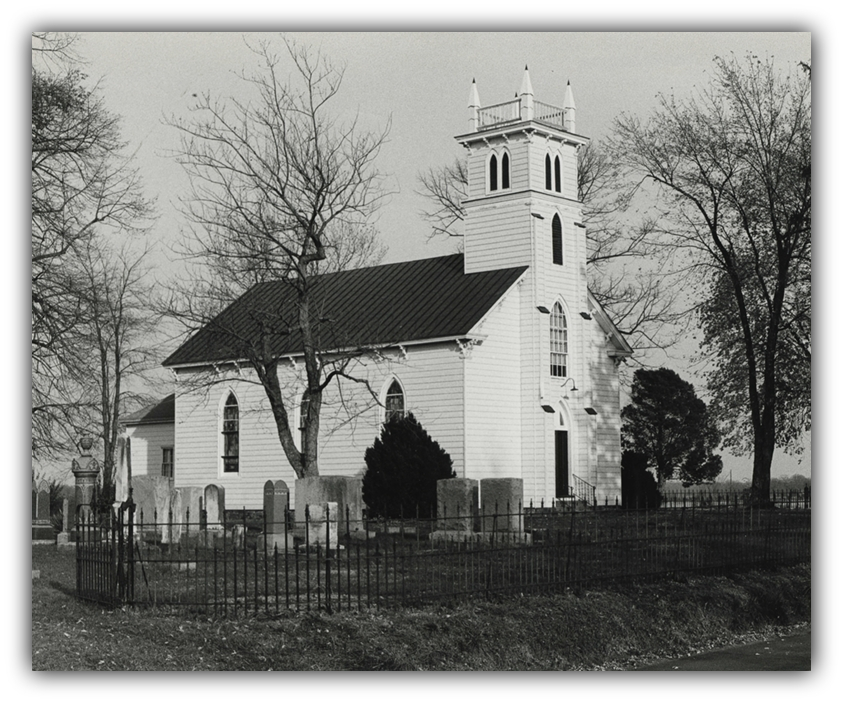
NATIONAL REGISTER OF HISTORIC PLACES
INVENTORY — NOMINATION FORM
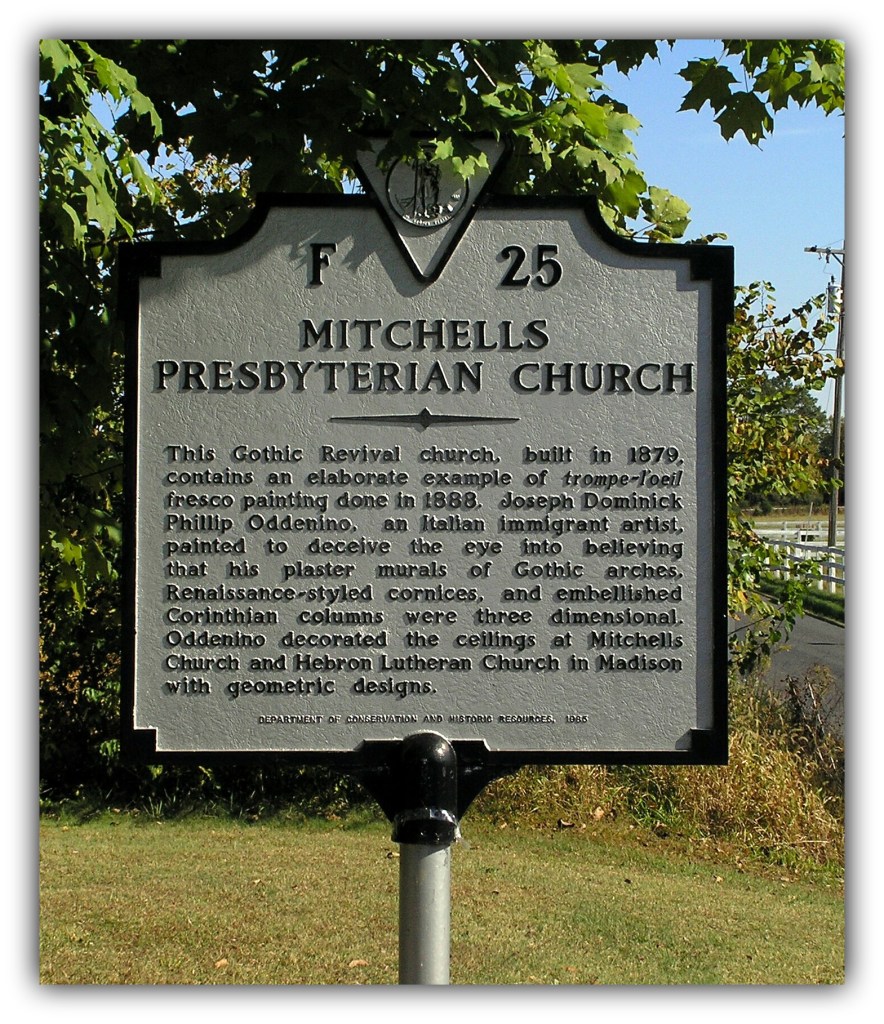
Mitchells Presbyterian Church is located off Route 652 at the small settlement of Mitchells, Culpeper County. The 50′ x 30′ structure was built in the Carpenter Gothic style in 1879, and the interior was extensively decorated in trompe I’oeil fresco between 1892-99. The building was extended to the northeast by the addition of an educational building in 1965.
Erected on a stone foundation, the wood-frame structure was originally covered with weather-boarding. White aluminum siding installed in the past decade now covers the building. The original wooden brackets at the eaves were retained. The main (south) elevation is dominated by an entrance tower that is defined by buttresses. The main entrance consists of a pointed-arch Gothic doorway that retains its original paneled double doors topped by a glass transom. The entrance is approached by three stone steps with a recently installed iron handrail. Above the doorway is a hung-sash, pointed-arch window. An early photograph shows that it was originally a three-part Gothic opening covered by louvred shutters. A lancet-type opening covered by a louvred shutter is found at the next level. The tower is crowned by a belfry that features paired lancet window on all elevations. Pinnacles joined by wooden balustrade complete the tower. The balustrade replaces the original merlons. Fenestration consists of pointed-arch Gothic openings with stained-glass windows. The gable roof is covered with standing-seam sheet metal.
The church contains one of the finest known l’oeil frescoed interiors in the Commonwealth. Painted by the Turin (Italy) native Joseph Oddenino, the paintings depict an eclectic range of architectural elements and details that decorate the north, east, and west walls and the ceiling. The east and west walls depict clustered columns with ornate capitals juxtaposed with pointed Gothic arches and rustication. The arches are painted to imitate stone-work, emphasized by the tones of buff, gray, and black. A painted cornice runs the perimeter of the decorated walls. The cornice contains Renaissance-style motifs. A similar motif is rendered on the painted coffered ceiling where quatrefoils imposed within diamonds are found with the panels. The north wall contains spiral and rounded columns, all with embellished Corinthian-typed capitals. A rounded niche contains a rear doorway and a semicircular stained-glass window. Later additions of memorial tablets on the north wall have tended to disfigure the original painted scheme. Stove flues added at a later date have marred the frescoes on the east and west walls.
The original lighting fixtures were insensitively replace within the last twenty years. The present pews date to the end of the 19th of early 20th century. A cast-iron fence, installed between 1892 and 1899, encloses the church yard and the adjacent cemetery.
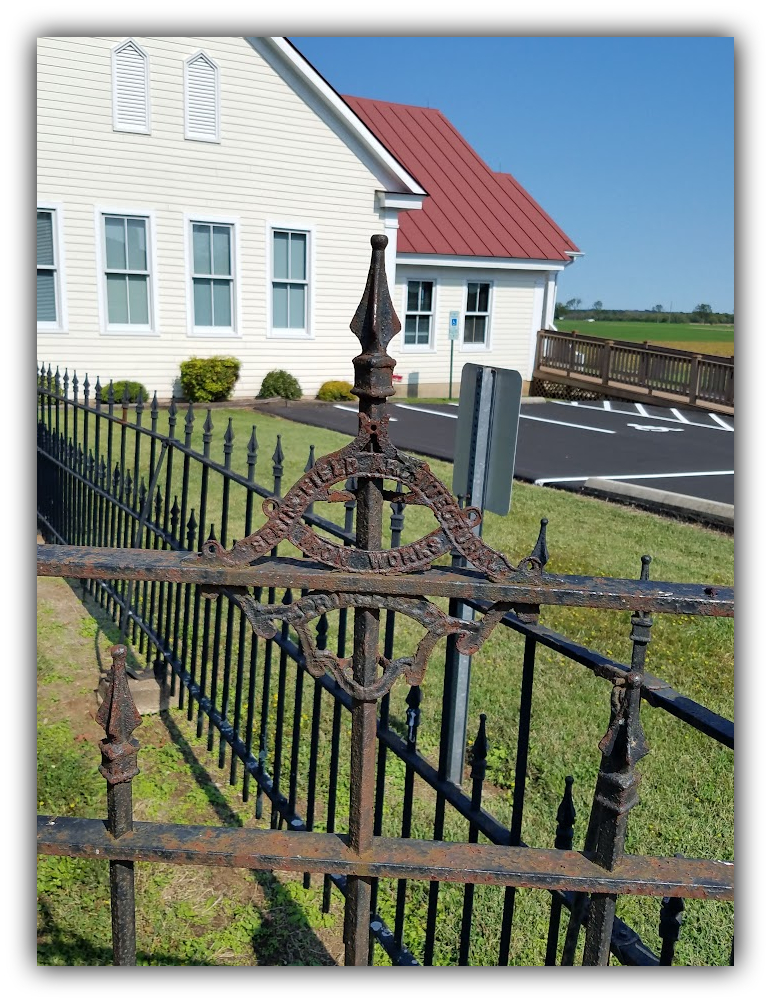
BOUNDRY JUSTIFICATION: The nominated property of three acres is a small plateau on which the church and the adjoining cemetery are located. The cemetery has been a part of the church yard since the church was built and contains the graves of the church fathers. The area is defined by a cast-iron fence.
STATEMENT OF SIGNIFICANCE: The simple, Carpenter Gothic Mitchells Presbyterian Church at Mitchells, Culpeper County, contains the most elaborate example of the late 19th-century, folk-styles trompe l’oeil frescoes in the Commonwealth. Executed 1892-99 by the Italian immigrant painter, Joseph Dominick Oddenino, the artwork is a curious transplant in the rural Virginia countryside of the ancient art of fresco common throughout Europe. Oddenino’s lively but naive architecture schemes, incorporating Gothic and Renaissance motifs, are suggestive of civic and religious fresco painting practiced for centuries in his native Italy. The church is one of several examples of the painter’s work that include fragments at the Hebron Lutheran Church in Madison County and the Culpeper County Courthouse.
The history of the Culpeper church begins in the early 18th century with the first large migration of Scotch-Irish Presbyterians to America. Many settles in Piedmont, Virginia, where they established the state’s first church. In 1814 the Bethesda Presbyterian Church at Culpeper Court House was organized, and in 1818 a mission church was formed at Cedar Run Creek, in the area know as Rapid Ann. The Presbyterian congregation grew, and by the late 1870s under the leadership of the Rev. John P. Strider, a new church was established at Mitchells Station. The new church was dedicated on November 6, 1879, and formally named Mitchells Presbyterian Church in 1888. By 1891 the was without a pastor and was struggling to survive. The Rev. E. H. Stover was hired, and his youth and energy infused new vigor into the congregation. It was under his ministry that the interior was painted by Joseph Oddenino.
Oddenino was born in 1831 at Chieri, Turin, Italy. He became head of the family linen manufacturing company where he designed patterns for fabrics. The heavy emigration of the period lured Oddenino to America, and he arrived in New York City in March 1862. On April 4 he was inducted into the Union army as a musician and was discharge April 4, 1865, at Harpers Ferry, West Virginia. His love of mountains brought him to the Piedmont region of Virginia where he reside alternately in Madison, Culpeper and Orange counties. He died in Madison County on September 23, 1913.
More info on Joseph Dominick Oddenino and his Civil War Service
Oddenino served in Company B, 5th Regiment of the New York Heavy Artillery from April 4, 1862 until his honorable discharge in March of 1865. Company B was recruited principally from Brooklyn and New York City. The company saw some action in a number of engagements, but the unit spent most of its time on garrison duty, especially in the Washington, D.C. area. Civil War records indicate that Joseph, as he was known in America, was on detached duty with the regimental band on June 20, 1864.
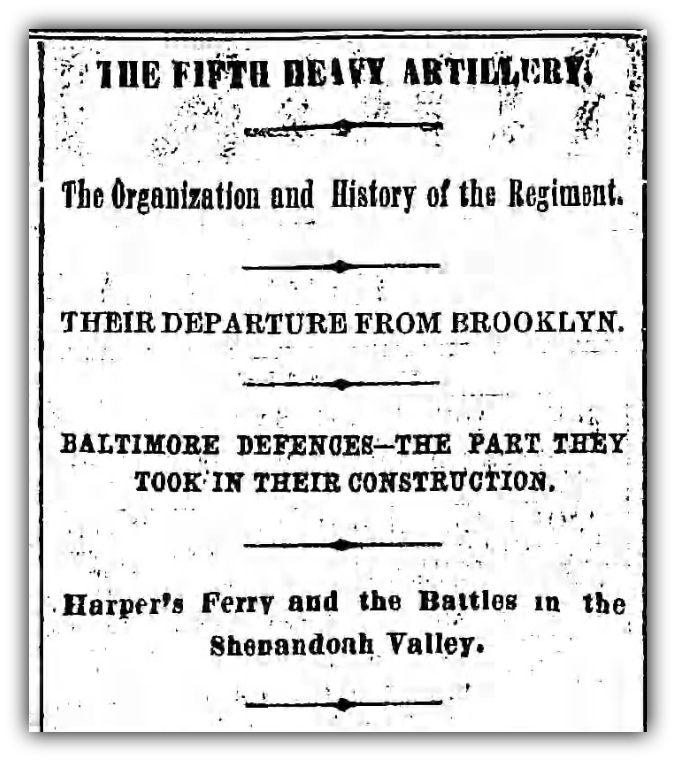
Thu, Jul 20, 1865 ·Page 2
The Fifth Regiment of Heavy Artillery was organized in this city by Samuel Graham on the 9th day of March, of 1862, and was originally intended to garrison the forts of New York harbor, so as to relieve a large number of Regulars and Volunteers which were detained here, and which was designed to send to the front, where their services were more urgently required. It was believed that the new regiment would soon be so drilled as to be equal behind forts and earthworks to soldiers of larger experience. About this time there was some uneasiness regarding the rebel privateers, which made sad havoc with our commerce, and who became so bold and confident that they threatened New York with demonstration. There was a feverish feeling thereto, and it was predicted by tried friends of the Republic as well as open foes that the rebel iron clads could easily pass the forts and lay New York under tribute. The Navy Department becoming more active, the necessity of the Fifth Artillery in our defenses became less urgent, and by the time it was raised the authorities were amply prepared to give any intruding vessels a very more reception, and the regiment was ordered to Baltimore, which was still with the South in sentiment and feeling.
THE DEFENCES OF BALTIMORE
The Fifth Artillery were immediately placed on the most active kind of duty in the construction of several fortifications in and about that city, the most prominent of which were Fort Marshall, and Fort No. 1 (called Stewart’s woods, in the western district of the city, which was constructed by Major Caspar Urban with his command, and which is situated in one of the most prominent and important positions.) Forts McHenry and Fort Federal Hill were also garrisoned by a portion of the Fifth Artillery. By these precautions the secessionists at Baltimore were kept in proper order. The regiment was looked upon as the main support of the citizen by the Union citizens.
PRESENTATION OF A FLAG
In the spring of 1863 the Common Council of Brooklyn voted a stand of colors for the regiment, at an expense, we believe, of $250. These were conveyed to Baltimore by a deputation of the military, headed by General P.S. Crooke, and by a committee of the city authorities, of which Alderman (now Senator) Demas Strong was Chairman, and they were presented to the regiment in Fort Marshall with due formalities. Since then these colors have seen some service.
THE SURRENDER OF HARPER’S FERRY
In the summer of 1862, Company A, Captain John A. Graham, and Company F, Captain Eugene McGrath, were detached for garrison duty at Harper’s Ferry, which position they filled with credit until the base surrender of the place by Colonel Ford. Some 12,000 men were taken prisoners and paroled to the rebels. The detachment of the 5th was sent to Chicago, and there remained until duly exchanged, when they again joined the regiment, and the whole body was sent to Harper’s Ferry on April 12, 1864.
THE FIRST BATTALION ON HUNTER’S RAID
The 1st battalion, under Lieutenant Colonel Murray, consisting of Co’s A, B, C and D, were ordered to join in Hunter’s raid to Piedmont (where they fought a battle) and Lynchburg. Retiring over the mountains under great distress for want of food, which gave out while pursuing the rebels, they fought several skirmishes in the vicinity of Harper’s Ferry, Winchester and Martinsburg. The battalion being very much exhausted, the 2nd battalion, consisting of Co’s G, H, F, and E, under command of Major Urban, were out to relieve them.
This battalion was compelled to take the brunt of every battle fought in the Shenandoah Valley under Gen. Sheridan, until the last engagement had be fought on the 19th of October last, when it had been reduced from 726 to 135, all the missing being killed, wounded or captured.
 Mairi & Dave's Gallivant Through Virginia and About