It had been arranged that the command should meet on the day after the raid, and accordingly the detail, after a good old-fashioned Virginia breakfast, hurried to meet their comrades. The place chosen for the meeting was Bloomfield, Loudoun County. After a ride in the bracing morning air Lieutenant Grogan and his detail reached the meeting, where they found the command drawn up under a large tree. Colonel Mosby was walking up and down and greeted the men most cordially.1
Like other communities of this era the Civil War action in Loudoun County greatly disrupted life, including life at Ebenezer Baptist. There are no minutes for the church business meetings between September 1861 and July 1865. A later notation in the minutes states that the “church has not met together for upwards of three years and the cause thereof was the war … the armies of both sides being in the neighborhood and our pastor being a prisoner nearly the whole of the above time.” Sympathizers with the Southern cause, anyone deemed to be an asset to Mosby and his raiders, were frequently imprisoned by Federal troops in an effort to drain support for him.
This area had sympathizers for both the Confederate and Union cause. The area around Waterford, Va. was a stronghold for the Union. The Loudoun Independent Rangers was an independent cavalry unit drawn from the largely Quaker and German farming communities of northern Loudoun County. Early in the war the Loudoun Independent Rangers clashed with the 35th Virginia Cavalry Battalion, also known as White’s Battalion. There are four members of White’s “Comanches”, the 35th Virginia Cavalry Battalion buried in the Ebenezer Cemetery. Both armies benefited from local sympathizers giving scouting reports for each of the combatants.
THE WASHINGTON HERALD, WEDNESDAY OCTOBER 14, 1914
FIFTY YEARS AGO.
October 14, 1864 – Col. John S. Mosby, with Eighty-four of His Partisan Rangers, Derailed a B. & O. Train Seven Miles West of Harpers Ferry and Secured $168,000 in Greenbacks from Two Paymasters of Sheridan’s Army – The “Greenback Raid.”
Fifty years ago today Col. John S. Mosby, the famous Confederate Partisan Ranger, with eighty-four of his men, derailed a train on the Baltimore and Ohio Railroad seven miles west of Harpers Ferry and secured $186,000 in greenbacks from two paymasters of Gen. P.H. Sheridan’s army.
This exploit, know among Col. Mosby’s followers was the most audacious of the many dashing feats in minor warfare performed by Col. Mosby. The derailment of the train took place on a railroad which was guarded by thousands of soldiers, between two of the principal garrison towns on the line, Harpers Ferry and Martinsburg.
Its success was due to the local knowledge of Mosby’s men of the road and the neighboring country, and to intelligent observation on the part of Mosby’s spies, two of whom visited the scene of the proposed hold-up in advance and selected the point at which the work could be most successfully accomplished.
The securing of the money – a fortune to the Confederates, in the then debased condition of their own currency – appears to have been a strike of luck, though it is fair to suppose that Col. Mosby had counted on the probability of the army funds being on train.
The raid was Col. Mosby’s first important undertaking since returning to his command after an absence of something more than a month, in which he was convalescing from a wound received when surprised by Federal Cavalry near Fairfax Station.
Waiting for the Train.
Every effort had been made by the Federals to catch Mosby’s men in Loudoun, Fairfax or Fauquier counties, but without success. Mosby continued to use the Blue Ridge Mountains as a screen to operate in the rear of Sheridan’s Army.
On the greenback raid Mosby and his chosen band – about one-third of his total command – crossed the Shenandoah River, below Snickers Gap, on the night of October 12. Riding next day across the valley toward Bunker Hill, they lay concealed near the pike, watching small parties of Federals moving along the highway between Martinsburg and Winchester. No force was seen to cause a swerving from the line of march toward the Potomac, and late that evening the party arrived at its selected point of attack on the train.
This was a cut between high rocks near Duffields Station, that could be approached by a ravine or gully.
Halting in this natural place of concealment, Mosby sent a small party down to the railroad to pull up tracks. It was his purpose to derail the train in the cut in order not to endanger the lives of the passengers by upsetting the cars.
The work on the roadbed was soon accomplished, and the command lay down to wait for a train bound east which would be the first to pass. It was a clear, cold night, and the time dragged to the men concealed in the gully beside the railroad. The east-bound train was late. At last, it was heard thundering down the track, but to the amazement of the watchers it passed without a halt. The fact then developed that only the westbound track had been broken.
Both tracks were now effectually broken, and the party resumed it waiting, this time for a westbound train.
Box Full of Money.
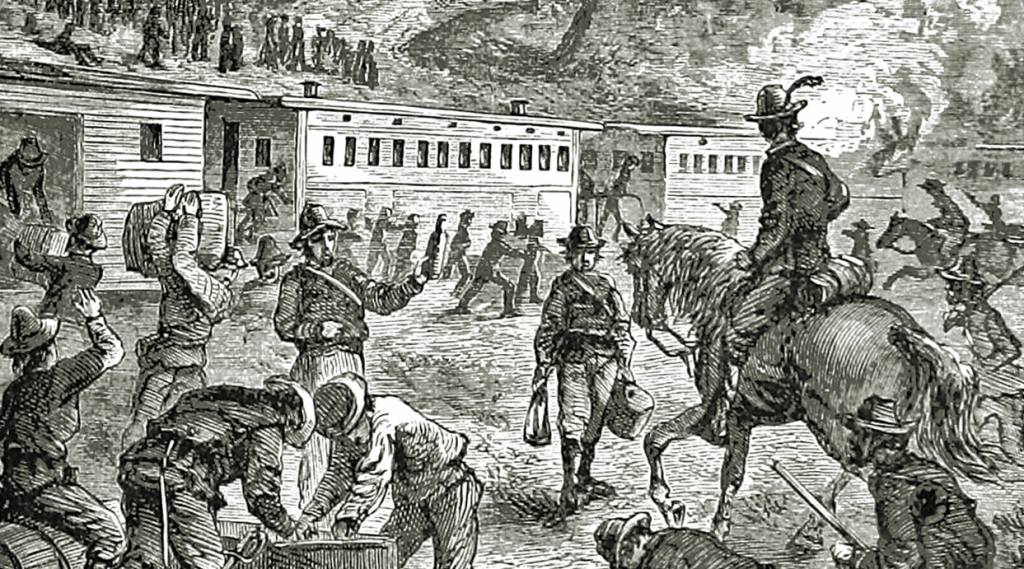
Between 2:30 and 3 a.m. the expected train came along at its usual speed. As the engine reached the point where the track was torn up it swerved and fell on its side, bringing the train to a standstill with a bump that startled the drowsy passengers.
As the Rangers poured down the embankment beside the train the conductor, lantern in hand, came forward and, peering at the faces of the men who surrounded him , said laconically: “Gentlemen, the train is yours.”
Two of Mosby’s men were sent into the train, each entering a car. One of them, Charles Dear, saw a soldier in the farther end of the car draw a revolver. A shot from Dear and the man dropped. None of the other passengers offered resistance.
Near the stove was a group of officers. Dear ordered them to surrender. As he approached them he noticed that one had a valise, which he tried to conceal. The other officers advised him to give up the valise, and this he did. Another officer had a tin box, and this also was secure. The bearers of the valise and box were Maj. David C. Ruggles and Maj. Edwin L. Moore, paymasters.
As yet the Confederates did not realize the extent of their good luck, but knowing the valise and box must be valuable, Col. Mosby assigned three of his men to take them and ride with all speed to the Shenandoah, cross and hide in the mountains.
As the men road off the horse of one stumbled over a stump, the box fell, and its contents were scattered on the ground. The eyes of the Rangers fairly bulged as they gathered up the contents. A fortune seemed before them. Hastily packing the money back in the box, they resumed their ride, reaching the mountains safely, and concealing themselves in a cabin to wait for an opportunity of rejoining Mosby.
Meanwhile, all passengers were ordered out of the ten cars composing the train and they were set on fair. One of the cars was occupied by immigrants, who, not understanding the cause of the trouble, refused to leave their card until the Rangers had set fire to the bundles of newspapers under several of the seats.
A “Study in Tactics.”
There was much alarm among the passengers, thus unceremoniously hustled out into the cold of a sharp autumn morning, in a rocky railroad cut, by armed men.
One woman, whose good looks commended her to the Rangers, dramatically call to Col. Mosby to save her, because her husband was a Mason. Mosby smiled and assured her she would not be harmed.
Another passenger was an Austrian officer, on the way to join Sheridan’s army. Mosby’s men asked him why he was going to the Yankees. He replied, “to study tactics.” They relieved him of his money and his watch and gravely informed him this was the first lesson in tactics.
Separating the Federal military men from the civilians among the passengers – there being twenty – the Rangers, seeing the train well enveloped in flames, set out with their prisoners on their ride back to the mountains.
Before news of their exploit had reached Harpers Ferry – for they had cut the telegraph – they were safe across the Shenandoah. Cavalry sent out from Harpers Ferry, Martinsburg and Bunker Hill scoured the country thereabouts all day without seeing a trace of Mosby or his men.
The next day Mosby reassembled his command east of the mountains, and by the rules under which the Rangers operated, the spoils of the greenback raid were distributed among the men who had accompanied Mosby. Each man received about $2,000, more money than most of them had ever seen, and more than any if them had seen since the war began.
- The Shepherdstown Register. Shepherdstown, W. V., Thursday, January 20, 1898, New Vol. 33. — No.12 ↩︎
 Mairi & Dave's Gallivant Through Virginia and About