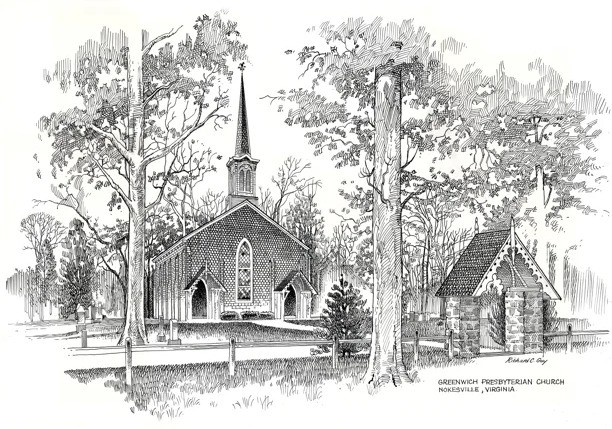
The Historical Significance of Greenwich Presbyterian Church During the Civil War
As we were transcribing the application for the Greenwich Presbyterian Church to be added to the National Register for Historic Places, we noted that it’s “Property Type” was listed as Mosby’s Confederacy and the Union Occupation. The application lists the Civil War Properties in Prince William County, and Greenwich is one of eleven. If you scroll way down, you will see an extensive addition to the application of an account of Bradford Smith Hoskins, an Englishman, and his participation in the American Civil War which is based on a report compiled by James L. Cooke in 1967.
Captain Hoskins was a professional soldier and fought with distinction in the Crimean Campaign. After returning to England, he sold his commission. He then joined the Italian Garibaldi in his Sicilian expedition. The American Civil War attracted his attention, and he offered his services to General Jeb Stuart, who in turn sent him to Colonel John Mosby. It is a very detailed account.
Mosby’s Confederacy and the Union Occupation in the Greenwich Area
Mosby’s Rangers and the Orange & Alexandria Railroad. The death of Captain Bradford Smith Hoskins. Recounted by James Joseph William, Private, Mosby’s Rangers May 29, 1863
The Orange and Alexandria Railroad was at this time closely guarded, the army on the Rappahannock receiving all its supplies from Washington by that route. Pickets were stationed at all the principal bridges and exposed places, patrols were sent from post to post, and each train was in charge of a guard. Yet in spite of all this vigilance Mosby never lost sight of the purpose for which he was detailed, and neglected no opportunity to harass and annoy the enemy.
On Friday, May 29th, there was a meeting of the command at Patterson’s. A small howitzer which General Stuart had sent Mosby at his request, was brought out, and the men selected for this branch of the service were put through a drill by Lieut. Samuel F. Chapman, who had been an officer in the Dixie Battery. Mosby then proceeded to Greenwich, where a halt was made for supper, after which he moved a few miles further on and camped for the night. Early on the morning of the 30th a hurried march was made in the direction of the railroad, coming out at a point near Catlett’s Station. After cutting the telegraph wire, a rail was unfastened and a wire attached to it, extended some distance from the road where the patrols would not observe it, while a man concealed behind a tree stood ready to draw the rail out of place as soon as the engine approached, throwing it off the track.
Soon the train came steaming along, but it halted suddenly on reaching the treacherous rail. The little howitzer had been placed in position by Lieutenant Chapman and a shot was fired into the engine, while a charge was made upon the infantry guarding the train. The guard fired a volley, and then, jumping from the cars, fled to the woods, leaving the train of eleven cars heavily loaded with supplies in possession of the Rangers, who took such articles as they fancied and then set fire to the train.
As there were cavalry camps within a mile on either side, the Rangers knew they could spend but little time in plundering, yet when mounted to return they were well laden with spoil, some with boxes of oranges or lemons, others with sides of leather, or mail bags, or boxes of dainties, hastily picked up, either by chance or from choice.
Colonel Mann, of the Seventh Michigan Cavalry, who was in command of that portion of Stahel’s Cavalry at Bristoe, hearing the firing, started the Fifth New York, under Captain Hasbrouck, across the country to intercept Mosby, while he followed the railroad towards the burning train, with the First Vermont and Seventh Michigan Cavalry.
Mosby had marched but a few miles when he observed the Fifth New York in his front. Chapman sent a shell into their ranks which checked their advance, and the command was again started. Mosby, finding his pursuers increasing in numbers (Col. Mann, with the Seventh Michigan, and Col Preston, with the First Vermont, having come up), determined to make a stand and sell his gun dearly.
Chapman took up a position near Grapewood Farm, about two miles from Greenwich, at the head of a short, narrow lane, with a high fence on either side. The Federals coming up, charged in column of fours, and at a little over fifty yards received a fire of grape which killed 3 and wounded 7. Mosby now made a dashing charge, which drove the enemy in confusion. Twice they rallied and each time were driven back. Our men fought bravely, but the odds were too great. At last when the ammunition was exhausted, the gun had to be abandoned, but only after a desperate hand-to-hand fight.
Mosby lost 5 men killed and about 20 wounded and prisoners. Captain Bradford Smith Hoskins, an Englishman, formerly a captain in the Forty-fourth Royal Infantry in the Crimean War, was with Mosby, and was mortally wounded. He lingered two days and died at the residence of Mr. Charles Green, near the scene of the conflict. He was a brave soldier, and had made many friends while with the command.

Lieut. Samuel F. Chapman, who was in charge of the gun, was so badly wounded that he could not be removed, and was paroled on the field. Beattie and Montjoy stood by the gun until surrounded and captured.
Mosby came out of the fight hatless, and his horse ran against a tree with him, bruising his face.
George Turberville made his appearance with a bunch of fresh fish, which he had brought from the captured train and carried safely through the desperate fight.1
Accounts of Mosby & His Raiders During the American by John S. Mosby. Regarding the death of Bradford Smith Hoskins
Hoskins was in the act of giving a thrust when he was shot. In an instant after, his adversary fell before a deadly revolver. Hoskins’s wound was mortal. When the fight was over, he was taken to the house of an Englishman near by, and lived a day or two. Thus died as gallant a gentleman as ever pricked his steed over Palestine’s plains. He had passed without a scar through the fire of the Redan and the Malakoff to fall in a petty skirmish in the American forests. I could not stay by him, and I had no means of carrying him off. The overwhelming numbers pressing upon us forced a retreat, and we had to leave him by the roadside with his life-blood ebbing fast away. The horse that I had presented to him disdained capture and followed us. I gave it to Beattie. He was buried in his martial cloak at Greenwich church, and now, like Lara, Sleeps not where his fathers sleep.
A History of the Greenwich Presbyterian Church
1810-1953 by Charles J. Gilliss
Excerpts from a pdf on the Greenwich Presbyterian Church website
Early Beginnings
Too much credit cannot be given to Mrs. Gilbert Moxley for her untiring and successful efforts to establish a Presbyterian Church in the Greenwich neighborhood, and for her nearly sixty years of unremitting labor in that Faith.
Aminta Elizabeth Moxley, wife of Gilbert Irland Moxley, was the daughter of Benjamin Douglas, and was born at Newport, near Port Tobacco, in Charles County, Maryland, on April 1, 1777. On April 22, 1802, she was married to Gilbert Irland Moxley, and came with her husband to “The Grove”, Greenwich, Virginia, where she lived until her death on December 31, 1858.
Soon after coming to Greenwich, Mrs. Moxley, herself perhaps the only Presbyterian in the neighborhood, began to hold religious services in her home, inviting in friends and neighbors. So popular became these services, that soon a small log building was erected to act as a place of worship. In 1810, a meeting took place in this little Church, in which a regular Congregation was organized, and if we are to believe certain records as found in the Library of Union Seminary, Richmond, this meeting of 1810 marks the beginning of our present Congregation in Greenwich Presbyterian Church, and comes down to us in an unbroken line, with variations of course.
By 1812, the Congregation had outgrown its place of worship, and the original log Church was torn down and its place taken by a new and larger log building, which was to serve for nearly forty-six years as a place of worship. This new log Church stood on the northwest corner of what is now the present Greenwich Church property, and at some unknown period, a well was dug close to its west wall; probably for use of the Congregation, but gradually came into use as a community affair.
In 1811, Mrs. Moxley lost her husband and was left a widow with four little daughters, which she could be seen dutifully leading to Church each Sabbath. Her entire life was devoted to the Presbyterian Cause, and when she passed away on December 31, 1858, she had lived to see the completion of the new Brick Church, and was laid to rest in the shadow of its walls, in the first grave to be made in the Church Yard.
The Church is Built
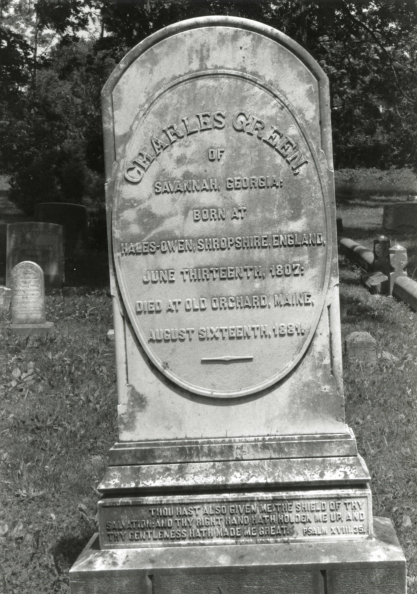
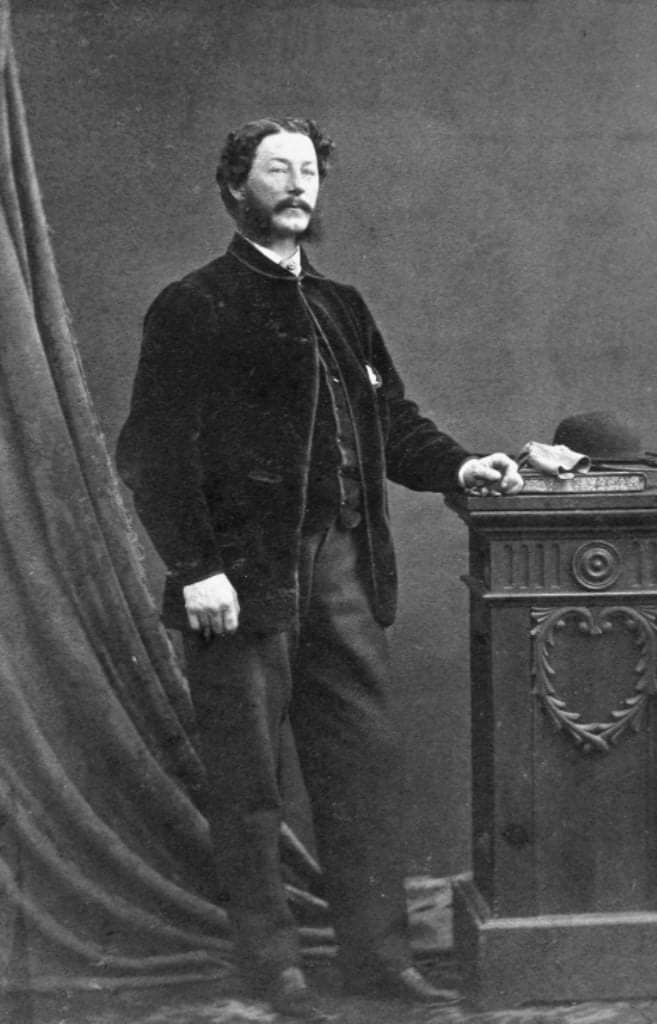
In 1833, Charles Green, an Englishman from Shropshire, came to Savannah, Georgia, where in time he established himself in business and became quite prosperous. That he was interested in Presbyterianism is shown by his attendance at the Independent Presbyterian Church of Savannah. Having a sister living in the Greenwich neighborhood, he used to visit her at times, and eventually become so fond of this part of the country that he purchased land here which he named “The Lawn”, and to which he added further tracts from time to time until he had 470 acres, on which he raised English sheep. He also married at Greenwich as his second wife, Lucy Irland Hunton, a daughter of Thomas L. Hunton, and a granddaughter of Mrs. Gilbert Moxley, who had started Presbyterianism at Greenwich.
Both Mr. Green and his wife became very much interested in the efforts of the Presbyterians of Greenwich, and to further their cause, purchased for their use, three acres of land, adjoining the site of the Log Church, and set about getting funds for the erection of a large Brick Church. Mrs. Green raised considerable of the funds necessary; a Mr. Wright of Savannah contributed generously, and Mr. Green made up the balance; the sum required being between $3,000.00 and $4,000.00. In 1854, the Congregation met to see the start of the foundation of the new Church, bringing with them picnic lunches. Mr. Spillman was the contractor and religious services were held in the open air by a Rev. Mr. Weems. By 1858, the new Church was completed and ready for occupancy, and the Congregation moved from the little old log building which had served their purpose for 46 years. However, in 1859, Dr. Moxley wrote to Mr. Green in Savannah, advising him that the walls of the new Church were beginning to bulge; that the steeple needed further bracing and that the roof was sagging and leaked badly.
Mr. Green replied under date of March 7, 1859, and requested that the contractor be required to brace the walls with three tie rods; to build brick foundation pillars under the floor, placing octagonal columns on them to the gallery and further columns to the base of the steeple; also to rebuild the roof in such manner that the arched ceiling could be used instead of a flat ceiling, and proper braces installed. All of these alterations were made, as may be noted in the Church today. He also notified Dr. Moxley, that matting for the Church was being shipped from Liverpool on the ship “Ann E. Hooper,” bound for Baltimore.
That Mr. Green gave a deed for the original three acres of land on which the Brick Church was built, there is not the slightest doubt, even though no record of the deed can be found. The surmise is that the book in which it was recorded, was one of those destroyed when Federal troops burned the Clerk’s Office at the Brentsville Court House in the early sixties. Proof that such a deed was given is shown by the fact that when the Northern troops attempted to seize the newly built Church for use as a hospital, Mr. Green objected strongly, stating that the deed therefore contained a draw-back clause, to the effect that the property should return to the heirs if it ceased to be used for religious purposes, which, said he, “would make it English property, as I am an Englishman.” The Church was not molested, which is the only instance of its kind that is known in this part of the country.
The log building (no longer used as a Church), was, however, seized at this time and used as a hospital by the Northern troops, and about the end of the war was burned, whether accidentally or otherwise, it is not known.
On October 11, 1856, Thomas L. Fitzhugh, Michael House and B. D. G. Moxley, Trustees, purchased for Greenwich Church, from James H. Moore and Harriet C. Moore his wife, for $55.00, a tract of land estimated to be between one and two acres, and described as follows: “bounded by the Greenwich Church lot on the West and three other public roads on the other three sides.” In other words, this was a narrow strip of land directly in front of and extending clear across the entire front of the Church lot, and its purchase would seem to have been extremely important. The Log Church stood in the north-west corner of this strip. Today, the Leach home is in the northeast corner, and as this belongs to “The Lawn”, a part of one of the roads probably originally ran between it and the Church property. For further details regarding sale of the Moore tract, see Liber 24, folio 295 of the Land Records of Prince William County, Va.
It will be noted that Thomas L. Fitzhugh and B. D. G. Moxley had both been ordained Elders under date of June 15, 1856. Michael House had been ordained as an Elder before October 11, 1856; the exact date not known. All of these men must have been very prominent in church affairs, for they were all Trustees on date October 11, 1856, and all are mentioned as the Elders in charge of the newly created Greenwich Presbyterian Church on its separation from the Warrenton Presbyterian Church, October 18, 1867.
Rev. John W. R. Pugh (he usually signed himself Bro. Jno. W. Pugh), came to Warrenton in 1852, probably about the time the Presbyterian Church of that place was destroyed by a tornado. He was installed November 17, 1855, which was the same year the corner stone of the new Warrenton Church was laid. He therefore saw the erection of the two Presbyterian Churches under his care; the one at Warrenton 1855-1856 and the one at Greenwich 1854-1858.
On October 18, 1867, when the Congregation of the Greenwich Church was granted permission by Rappahannock Presbytery to become a separate and independent Church, Mr. Pugh continued to act as their Pastor, in addition to being the Pastor of the Warrenton Church, until the date of his resignation on September 27, 1868.
The Church Building Itself
Our history would hardly be complete without some thing regarding the interior and exterior of Greenwich Church.
On some very early date, probably soon after completion of the new Church in 1858, a pipe organ was placed in the arched space directly back of the pulpit. Being before the days of electricity in the community, this organ had to be pumped by hand, and Elder George Wood recounts how this used to be his job when a boy. Considerable trouble was experienced by mice building nests in the organ, and soon after 1900, when a part of the ceiling fell, the organ was totally ruined. The ceiling was soon replaced with a metal one, and on November 22, 1903, the Session Instructed the Ladies’ Aid Society (forerunner of the Woman’s Auxiliary), to purchase a new reed organ; the old organ to be taken in as $50.00 credit on same. This reed organ was used until about 1949, when its place was taken by the Hammond Electric Organ, gift of the Ellis Family.
Originally at the extreme front edge of the platform, and directly in front of the pulpit; used to be a low solid fence, back of which the Choir sat. This fence was removed early in the nineteen hundreds, and the Choir was placed in the south-east corner where the electric organ is today.
All that can be gathered about the original pulpit was that it was massive and beautiful. Why it should have been removed, we have no idea. The Session under date of October 22, 1909, extended their thanks to a Mr. Kronk for the gift of a pulpit and a reading stand. This is the pulpit in use today; the reading stand is now doing duty in the Hall.
On July 2, 1910, the Session extended thanks to Miss Mabel Wagner for her gift of two marble tablets containing the Ten Commandments. These are now on the wall, in the arch-way originally occupied by the pipe organ.
There are three marble tablets in the south end of the Church; that in the left corner being in memory of Lucy Irland (Hunton), second wife of Charles Green, and a member of the Congregation until her death in 1867. The tablet in the right corner is in memory of Charles Green, and a tablet on the west wall and near the south corner, is in mernory of Jane Alexander Milligan, founder of the Ringwood Academy. A small bronze tablet, in the center and just below the Ten Commandments, is in memory of Aminta Elizabeth Fisher, third wife of Charles Green, and donor of the Moxley Memorial Manse in 1906.
On the outer rail of the balcony and facing the pulpit, used to be an extrernely large circular gilt clock, which now seems to have disappeared. This clock had not run for years.
It is natural that at the building of the present Church, an opening should be made to the public roads, both on the East and the West, for hauling needed materials for construction. To the North, directly in front of the building, was a narrow strip of land, owned by James H. Moore, and while this was soon purchased by the Church in 1856, it was at the beginning not feasible to make an entrance to the north. For many years, the side entrances were used exclusively for carriages and horses, and on each side of the Church yard proper, were erected stiles modeled after doorways in England, for use of those alighting for services. A careful study of some of the large oak trees nearby, will disclose iron rings, almost grown over by the bark, to which horses used to be hitched. These picturesque old stiles still remain as they were.
On August 2, 1908, it was ordered that a new fence be erected around the Church Yard. This would indicate that there had been a previous one but evidently the Iron fence of today was erected in 1908. It used to be customary to have “clean-up day” once a year and at that time, some of the men would repaint the fence.
It was possibly about 1908, that complaint was made that the public were making a thoroughfare through the east and west gates; also that it was not possible to keep stray cows and horses out. Accordingly, both gates were permanently closed up, and a new gate was opened directly in front of the Church, which could be closed with an iron gate at will.
In 1952 a beautiful stone entrance was erected by Mr. and Mrs. John Ellis as a memorial to their only son Gordon, who gave his life in World War II.
In the same year damage caused by termites led to an extensive repair and renovation program in the church building. The entire floor, which had been of wide pine boards, had to be removed, and new joists were laid. Most of the wainscoting had to be replaced. While the floor was removed, an automatic furnace was installed Then new oak flooring was laid on a substantial sub-floor. A center aisle replaced the old double aisles which led directly from each door to the front of the church. The church was lightened by changing the pews and wainscoting from mahogany to ivory in color. The pulpit furniture was refinished and in some cases replaced. Carpeting and choir curtains, given by The Women of the Church, completed the redecoration. The result is a place of quiet reverence and radiant beauty.
The following is the complete transcript of the United States Department of the Interior National Park Service, National Register of Historic Places Registration Form dated July 5, 1989, and prepared by Jan Townsend, County Archaeologist, Prince William County Planning Office, May 1989. Entered into the National Register August 18, 1989.
SUMMARY DESCRIPTION
This historical property consists of a church that is an excellent example of a rusticated Gothic Revival rural church and its associated cemetery. The church, which was built in the late 1850s, is a one-story, gable-roofed brick building with two pointed-arched front doors, decorative buttresses on the side walls, and large, pointed, arched windows on the front and side walls. Small gable-roofed porches supported by rustic cedar posts are located in front of each entry door. A distinctive, wooden church tower is atop the church. The inside of the church was renovated in the 1950s; the outside appears as it did in the 1860s. The adjacent cemetery includes at least 100 headstones. Several civil War soldiers are also buried here, including Captain Bradford Smith Hoskins, a colorful Englishman who rode with Colonel John Singleton Mosby.
There is one noncontributing structure on the property. It is a more modern building that is used as a Sunday school and for meetings. The church and the cemetery are in very good condition and have a high degree of historical integrity. The setting is very peaceful.
DESCRIPTION
Greenwich Presbyterian Church is an excellent example of a rusticated Gothic Revival rural church. It is one story; the foundation and walls are brick. The church structure is about 52 feet by 35 feet. The gable roof is covered with asphalt shingles. The brick walls are laid in 7-course American bond with scored mortar joints. There is a molded brick water table all around. The front doors have pointed arches and are constructed in diagonally-laid board and batten style. The large, pointed-arched, sliding sash windows have pastel-colored diamond panes.
Exterior decorative elements include a sawtooth-design, molded brick cornice; decorative buttresses, which define the bays and separate the four lancet arch sliding sash windows on each long side; and twin front entrances, each of which has a shingle covered, gable-roofed, one-bay porch supported by rustic cedar posts. Each porch entry also has decorated bargeboards with pendant and finial. The wooden church tower has a louvred belfry and a shingle-covered spire topped by a weathervane. A small wooden shed, covered with brick-design asphalt sheeting, abuts the back wall of the church, but is out of view unless one is directly behind the building.
The interior is plain. Two rows of box pews painted white with dark accents fill the church. The walls are plaster. The ceiling is coved. There is a crown moulding, and waist-high, beaded wainscotting around the entire room. A winding, enclosed stair opposite the left entrance rises to the balcony, which is supported by eight-sided wooden posts. There is a low platform at the altar end containing a lectern and other church furniture. Wooden pilasters attached to the altar end wall describe a Tudor arch.
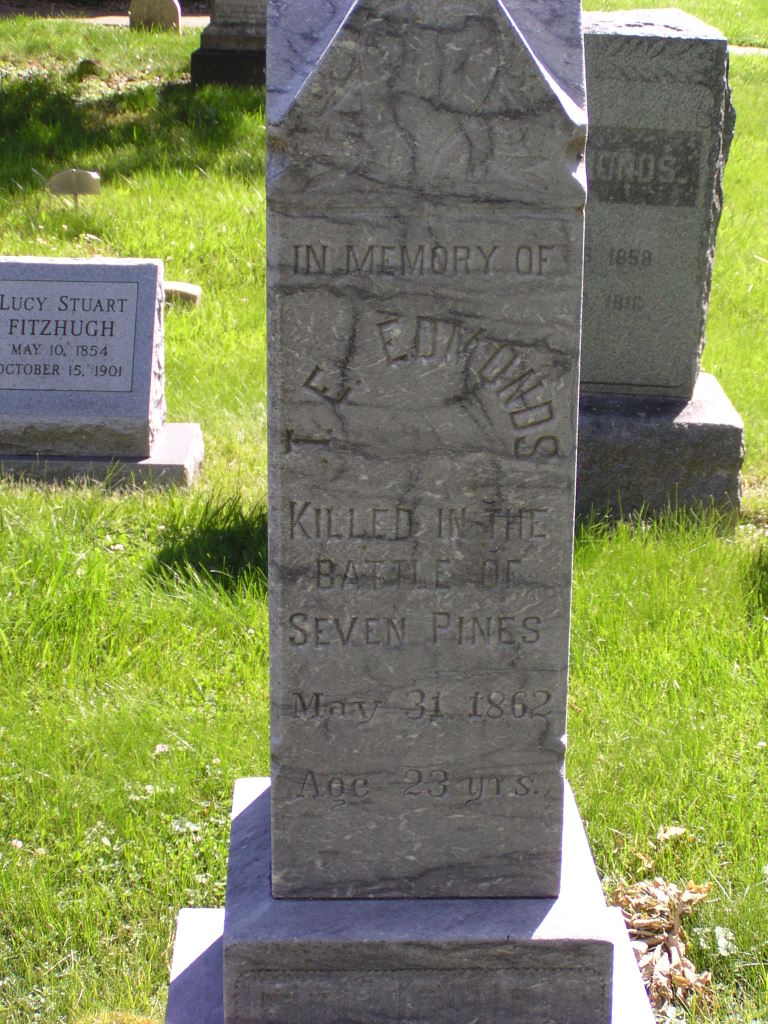
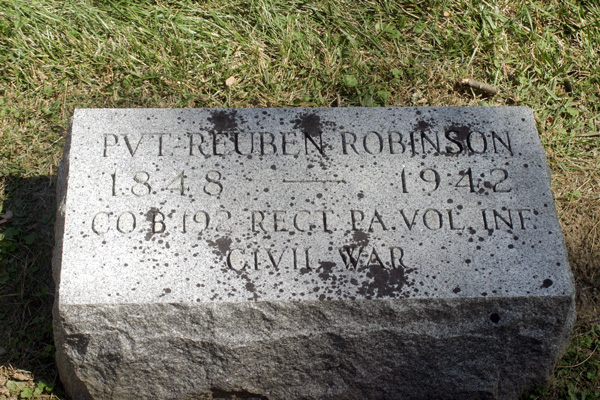
In the churchyard is a cemetery containing more than 100 headstones representing the Mayhugh, Sinclair, Thornton, Moxley, Washington, and Green families, among others. In addition, there are gravestones for several Civil War soldiers including Pvt. Reuben Robinson (1848-1942), Co. B, 192d Regiment, Pennsylvania Volunteer Infantry, and T. E. Edmonds, who was killed in the Battle of Seven Pines and died on May 31, 1862, at the age of 23 years. According to T. E. Edmonds’s headstone, S. I. Edmonds and J. B. Edmonds died on Apri l 26, 1862, and March 29, 1862, respectively. Both of these individuals were in their early twenties and likely died in a Civil War camp where epidemics were commonplace. The most significant and impressive headstone belongs to the Civil War soldier Bradford Smith Hoskins, who rode with Mosby. Hoskins’s story will be discussed in greater detail in the “Statement of Significance “section.
The church and cemetery are surrounded by a wooden rail fence, and the lo t has many established trees and shrubs. A historical marker, which was placed by the Prince William County Historical Commission and describes the history of Greenwich, is located near Vint Hill Road. The parking lot is gravel. The back part of the lot is wooded. Although the church has roads on three sides, they are not well-traveled. As a result, the overall setting is very peaceful.
The existing church was built from 1854 to 1858. Mr. Spillman was the contractor. Extensive repairs had to be done the year after it was built. According to church records (anonymous n.d.:3), the walls of the new church began to bulge, the steeple needed further bracing, and the roof was sagging and leaking badly. The contractor was required to brace the walls with three tie rods; to build brick foundation pillars under the floor, placing octagonal columns on them to the gallery, and further columns to the base of the steeple; rebuild the roof so that the arched ceiling could be used instead of a flat ceiling; and install braces.
An iron fence was erected around the churchyard in 1908—it has since been replaced by the wooden fence. The type of fence used prior to 1908 is unknown. Originally, one could enter the churchyard by way of gates on the east and west side of the yard. About 1908 these entrances were blocked (gable-roofed structures still mark the location of these entrances). An entry gate was then built on the north side of the property, where it is today. (anonymous n.d.:14)
The original ceiling fell in about 1900, and it was replaced with a metal one. The present pulpit was given as a gift in 1909. The original pulpit was apparently massive and beautiful, but no record remains describing it or what happened to it.
In 1951 repairs were made to the church interior. The floor, consisting of wide pine boards that had been destroyed by termites, was replaced with new oak flooring. While the floor was up, an automatic furnace was installed. A center aisle was constructed to replace the former double aisles that led from each door to the church front. Much of the wainscoting had to be replaced, and the mahogany-colored pews and wainscoting were painted a light color. (anonymous n.d.:14)
The church and cemetery are in excellent condition. There is one noncontributing building on the church property. It is located to the west of the church and consists of two structures joined together by a passageway. One of the structures is a two-level, brick and cinder block building that was built in 1948 to serve as a meeting place and a Sunday school building. In 1972 the Education Wing, a one-story, modern-style brick building, was built next to the Sunday school building. They are now connected.
SUMMARY SIGNIFICANCE STATEMENT
Greenwich Presbyterian Church is the only example of a rusticated Gothic Revival church in Prince William County. Its exterior appears as it did when it was built in the late 1850s. The church has a number of distinctive architectural features including pointed-arched doors and windows, a prominent wooden church tower, buttresses, and unusual rustic posts supporting gable-roofed porches in front of each entry. Charles Green, of The Lawn, donated the land for the church and paid for its construction. During the Civil War, he convinced Union military leaders that the church was technically English property and could not be taken over by Union troops. Greenwich Church is the only church in the County that was not damaged by Union troops. Its integrity is excellent. The graves of Captain Bradford Smith Hoskins, the Englishman who rode with Colonel John S. Mosby, and several other Civil War soldiers are located in the cemetery.
HISTORICAL BACKGROUND
The Greenwich Presbyterian Church was organized in 1802 when Aminta Elizabeth Moxley, wife of Gilbert Irland Moxley, began holding services in her house. The Grove, located at Greenwich. Eventually, a small log structure was built for church services, and the congregation was officially organized in 1810. In 1812 a larger log structure was built as a church on the northwest corner of the present church property.
About 1854 Charles Green, an Englishman who had settled in Savannah, Georgia, purchased land in Greenwich and named it The Lawn. He also married his second wife, Lucy Irland Hunton, who was a granddaughter of Mrs. Gilbert Moxley. The Greens acquired 3 acres beside the log church for a new church and largely financed the construction from 1854 through 1859 of the present-day brick church. The minister during the construction of the Church was Rev. John W. R. Pugh. The deed for the original three acres given by Mr. Green cannot be found. Church officials assume that it was destroyed during the Civil War along with the numerous other records that were located at the Brentsville Courthouse (anonymous n.d.:3).
The brick church was not taken over by Union troops or damaged during the Civil War, which may be the only instance of its kind in this part of the state. When Union troops attempted to seize the newly built church for a hospital. Green strongly objected. He argued that the deed contained a draw-back clause stating that the property should return to the heirs if it ceased to be used for religious purposes. This meant that it would revert back to him and, since he was an Englishman that would make the church English property. Union officers accepted this argument for the brick church, and it remained untouched. The log building (the former church), however, was used as a hospital and at the end of the war was burned by the Union troops. Whether the fire was intentional or not is unknown, (anonymous n.d.:3-4).
The most predominate marker in the churchyard belongs to Bradford Smith Hoskins, an Englishman who rode with Col. John Mosby. The inscription reads: “In memory of Bradford Smith Hoskins, son of the Reverend W. E. Hoskins, Rector of Chiddingstone, Kent, England, Late Captain in Her Britannic Majesty’s Forty-fourth Regiment. He fell near this place XXXI May MDCCCLXIII, AE XXX years.”
The following account of Hoskins’s participation in the American Civil War is based on a report compiled by James L. Cooke in 1967.
Captain Hoskins was a professional soldier and fought with distinction in the Crimean Campaign. After returning to England, he sold his commission. He then joined the Italian Garibaldi in his Sicilian expedition. The American Civil War attracted his attention, and he offered his services to General Jeb Stuart, who in turn sent him to Colonel John Mosby. Captain Hoskins, in his neat British uniform stood in contrast to Mosby’s rangers, most of whom had no uniform at all.
Spurning the pistol, which Mosby required his men to carry. Captain Hoskins fought with his sword and was an accomplished swordsman. According to Mosby, in Hoskins’s first engagement, which was at Chantilly, Hoskins cut a path through the Federal cavalry with his sword. He fought in a number of mounted fights between Mosby’s rangers and troops of the U.S. cavalry and became well-respected for his fighting g skills.
In April 1863, at Miskill Farm, a few miles north of Leesburg, Mosby and 69 of his men were surprised by two groups of Federal cavalry composed of 150 seasoned fighters. Most of Mosby’s men were asleep in the barn, and none of the horses were saddled or bridled when the attack occurred. All was confusion as the rangers grabbed for their horses. Some rode without saddles—but all had revolvers that they used against the sword-wielding Union troops. Hoskins was in the thick of it, his British sword clashing with Yankee sabers. Mosby’s men shot the Union captain and his horse and killed a lieutenant and nine others. Fifteen Union soldiers were too badly wounded to be moved. Mosby’s rangers led away 82 prisoners.
On May 29, 1863, Mosby and 48 men left the vicinity of Aldie and headed into Prince William County. They had obtained a small howitzer and planned to use it to disrupt rail traffic supplying General Hooker’s army on the Rappahannock River. Mosby and his followers galloped up the Carolina Road to the tiny village of Greenwich. They stopped at The Lawn, the home of Charles Green. It is unlikely that Mosby was acquainted with the Green family. There were men in his command, however, who were related to Mrs. Green, the former Lucy Irland Hunton. The rangers were made welcome and particularly so since Green and Hoskins were fellow countrymen. Refreshments were served in the drawing room. It is said that Mosby played the piano, and the whole group sang and cheered him on in great style.
Soon Mosby and his men were off, riding south on Burwell Road. That night they camped in the vicinity of Kettle Run. The next morning they were awakened by reveille from the Union camps up and down the railroad . They broke camp and soon reached their destination. Quietly they pried a rail loose and attached a wire that ran back to the underbrush along the tracks. The howitzer was readied and they waited. After a seemingly long time, a train was sighted coming from the Nokesville area.
With a loud clatter and clash, the locomotive hit the spot where a moment before the rail had been jerked away. Slowly the engine and several cars settled down on the crossties. Mosby’s men were firing as they rushed the train. Fire was returned by Union soldiers on the train. Two shots from the howitzer, however, lead the northern troops to believe that a large military force was attacking, and they retreated into the woods on the other side of the train. The rangers gathered what they could and quickly set about burning the rest. The smoke, however, alerted those in the nearby Union camps. The howitzer was limbered up; and with loot tied to their saddles, Mosby’s men started back up the road towards Greenwich.
They had not gone far when the Fifth New York Cavalry appeared on the road in front of them. The howitzer was unlimbered and a shell was thrown at the approaching troops, scattering them. The Union cavalry unit reformed and continued to pursue Mosby’s group. After several exchanges, Mosby decided he would have to stand and fight. He sent Sam Chapman on ahead to find a suitable place for setting up the howitzer and taking a defensive stand.
To slow the Federal cavalry, Mosby, Captain Hoskins and three others turned and dashed into the midst of their pursuers. Two Union men dropped, but others closed in. Captain Hoskins fell from his horse mortally wounded. (Jones 1972:127) Mosby and the three remaining men retreated. They joined Chapman and the others, who had positioned themselves at the top of a small lane leading off the Carolina Road. (The site is just across the County line in Fauquier County.)
Federal troops gathered at the foot of the lane and charged up in a neat column of four. At fifty yards, the howitzer fired canister. Ten Union men dropped from their saddles and the rest faltered. Out dashed Mosby and his men, driving the Union soldiers back down the lane and up the road about a half mile. There the Union troops met reinforcements and regrouped. Mosby and his men returned to the gun location. The Federals charged three more times and were thrown back. Mosby, recognizing his weak position, signaled his men to disperse into the surrounding woods. The few rangers still fighting on foot around the gun were overpowered. Most, however, escaped. One ranger was captured, and Sam Chapman was seriously wounded.
The Union troops began caring for their wounded and collecting their dead. They also readied the howitzer, which had originally belonged to the Union army, for transport back to their camp.
It is probably at this time that Mr. Green came up the road in his cart being pulled by oxen. (His horses had been previously commandeered by the Union army.) He stopped and picked up Hoskins and then proceeded up the lane, where he offered ice water and brandy to Union soldiers. Because he was believed to be too seriously wounded to be taken as a prisoner, Sam Chapman was loaded onto the cart with Captain Hoskins. The wounded men were taken back to The Lawn, where they were placed under the care of Mrs. Green and her mother, Mrs. Hunton. Chapman recovered from his wounds and later rejoined Mosby. Captain Hoskins, however, was too seriously wounded and died.
At the request of Captain Hoskins’s father, over the captain’s grave, Mr. Green erected a monument surmounted by a cross bearing the inscription “In Hoc Signo Vincos” (In This Sign You Will Conquer).
- Williamson, James Joseph. Mosby’s Rangers: A Record Of The Operations Of The Forty-Third Battalion Virginia Cavalry, From Its Organization To The Surrender (p. 43). Lector House. ↩︎
 Mairi & Dave's Gallivant Through Virginia and About