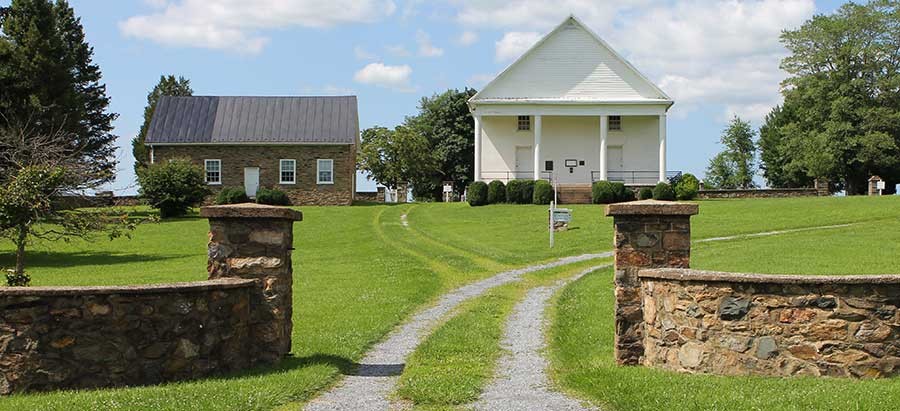
The Old Ebenezer Church, often referred to as Butcher’s Meeting House or the Ebenezer Meeting House, may have been built before 1769 on land owned by Samuel Butcher, Sr. His will of September 12, 1769, gives two acres of his land for the use of “the Baptist Meeting House and School House,” describing those two acres as “the same that the Meeting House is now built upon.” It was not until April 1804, however, that the Ebenezer Church was constituted when nine members of the Goose Creek Baptist Church and eight from Ketoctin Baptist Church were dismissed from their congregations for the sole purpose of constituting a new congregation.
One of the most defining aspects of these Churches is the cemetery. Between the old and the new cemeteries there are just short of 2000 graves. The older cemetery contains about 235 stones with dates ranging from ca. 1800 to 1905; the newer cemetery contains more than 1700 gravestones with dates ranging from 1888 to the present, including the graves of 13 Veterans of the Revolutionary War, 34 Veterans of the War of 1812, and 30 Confederate veterans who were buried there between 1863 and 1929.
The wall surrounding the old cemetery probably was erected after 1804, when the will of John Butcher, oldest son of Samuel Butcher, Sr., gave the use of his plantation, upon the death of his wife to “the church formerly caller Butcher’s meeting house, but now called Ebenezer” to be rented out with 100 pounds of the rent money to be put toward a wall to enclose the cemetery.

Civil War History
Like other communities of this era the Civil War action in Loudoun County greatly disrupted life, including life at Ebenezer Baptist. There are no minutes for the church business meetings between September 1861 and July 1865. A later notation in the minutes states that the “church has not met together for upwards of three years and the cause thereof was the war … the armies of both sides being in the neighborhood and our pastor being a prisoner nearly the whole of the above time.” Sympathizers with the Southern cause, anyone deemed to be an asset to Mosby and his raiders, were frequently imprisoned by Federal troops in an effort to drain support for him.
This area had sympathizers for both the Confederate and Union cause. The area around Waterford, Va. was a stronghold for the Union. The Loudoun Independent Rangers was an independent cavalry unit drawn from the largely Quaker and German farming communities of northern Loudoun County. Early in the war the Loudoun Independent Rangers clashed with the 35th Virginia Cavalry Battalion, also known as White’s Battalion. There are four members of White’s “Comanches”, the 35th Virginia Cavalry Battalion buried in the Ebenezer Cemetery. Both armies benefited from local sympathizers giving scouting reports for each of the combatants.
This area of Loudoun County was continually a pathway for the armies of both North and South. The Army of the Potomac came to Loudoun County for the first time on October 26, 1862, when it began crossing the Potomac on two pontoon bridges at Berlin. Two divisions of infantry and a cavalry brigade crossed first, driving Confederate pickets as far back as Snicker’s Gap. On the evening of October 28 John Pelham, an artillery officer who served with the Confederate cavalry under J.E.B. Stuart, arrived from Millwood and camped with his battery on Seton Hill, a few miles north of Middleburg. He would move on the next day to join Stuart and Wickham in Bloomfield.
Stuart was to move quickly with an attack on three companies of the First Rhode Island Cavalry at Mountville, where the Snickersville Turnpike crosses Goose Creek. Leaving his Bloomfield bivouac before dawn on October 30, he approached the village by a cart path and surprised the Yankee camp. The charge by the Ninth Virginia Cavalry killed Lieutenant L.D. Gove, the picket commander, and netted fifty prisoners. The rest fled for their lives down the road to Aldie with the Confederates in hot pursuit. As they reached the outskirts of that town, the Confederates found themselves facing the brigade of George D. Bayard, who had come from his camp near Chantilly that morning on a scout toward Ashby’s Gap. While Wickham prepared to attack, Pelham’s battery traded shots with the Union artillery. Just then, Stuart received word that another large Union force was coming up in his rear from the direction of Leesburg. Moving down the Cobb House Road to the Ashby’s Gap Turnpike, he withdrew to a strong defensive position near Middleburg. Bayard, believing that he was facing a superior enemy force, was withdrawing too, leaving eight of his men dead on the field.1 The armies continued to pass through this area during the war.
The most famous incident, tied by tradition to Ebenezer Baptist Church Bloomfield, although not reported officially, was known as the “Greenback Raid”.
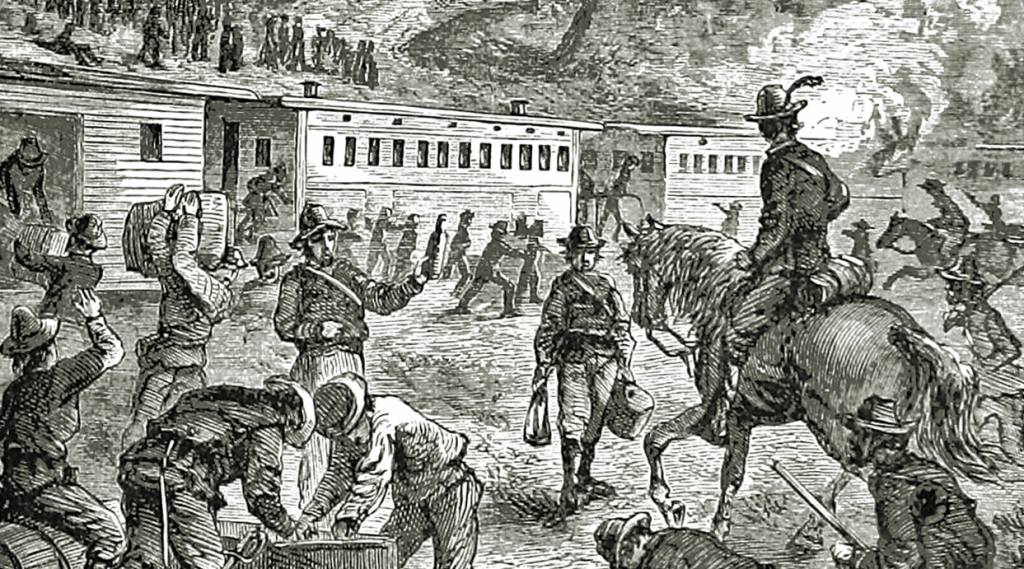
Report by the DAILY EXAMINER, Richmond, Virginia, October 18, 1864: “From the Valley–Capture Of A Railroad Train”
No later movements of importance in General Sheridan’s department are reported, but we hear of dashing operations of our forces along the Potomac. A dispatch from Martinsburg says:
Mosby made a most audacious & successful attack upon the westward bound railway express train, eleven miles east of this point, at a place known as Quincy Siding. The engine was thrown from the track and two paymasters and several other officers were captured, with over two hundred thousand dollars in Government funds.
The passengers were robbed of their money and valuables, and the cars set on fire, burning all the property and two persons, who could not be ascertained. The engineer and fireman were badly scalded, and their recovery is doubtful. Some of the ladies lost all of their baggage, and Mosby, who was present himself, told them in politest tones it should be restored to them; he, however, rode off and forgot it.
The two paymasters were Majors Ruggles and Moore, who together had something over $200,000.
From the Memoirs of Colonel John S. Mosby
The following dispatch shows what General Lee thought of the importance of the blow I struck.
Chaffin’s Bluff, October 16th, 1864.
On the 14th instant Colonel Mosby struck the Baltimore and Ohio Railroad at Duffield’s, destroyed U. S. military train consisting of locomotive and ten cars, securing twenty prisoners and fifteen horses. Amongst the prisoners are two paymasters with $168,000 in Government funds.
(Signed) R. E. Lee, General. Hon. James A. Seddon, Secretary of War.
The paymasters and other prisoners were sent south to prison, and one of them, Major Ruggles, died there. They were unjustly charged with being in collusion with me, but their capture was simply an ordinary incident of war. As the Government held them responsible for the loss of the funds, they had to apply to Congress for relief. After the war, Major Moore came to see me to get a certificate of the fact that I had captured the money. The certificate stated that my report to General Lee of $168,000 captured was based upon erroneous information and was sent off before I had received the report of the commissioners appointed to count and distribute the money. The sum captured was $173,000.
The attack was made on the train on the night of October 13 between Martinsburg and Harper’s Ferry. During the day, as the following dispatch shows, we had operated on the Valley Pike and moved at night to the railroad.
[Seward, at Martinsburg, to Stevenson, at Harper’s Ferry] Four scouts have just arrived and reported that they were attacked about eight miles this side of Winchester by a party of fifty guerrillas this afternoon. They all seem to be positive that they were attacked by Mosby’s men and that Mosby with one foot bound up was with them.
It is true that I was there and with one foot bound up. In fact I had on only one boot. I suppose the scouts heard this from some citizen who saw me. A few days before my horse had been shot in a fight, and a Yankee cavalryman rode over me. His horse trod on my foot and bruised it so that for some time I could wear only a sock and had to use a cane when I walked. I was in this condition when we captured the train.
[Stanton, Secretary of War, to Stevenson, Harper’s Ferry] Washington, October 14, 1864. It is reported from Martinsburg that the railroad has been torn up and a paymaster and his funds captured.
When and where did this occur and have any measures been taken for recapture? Immediate answer.
[Stevenson to Stanton] Just heard from captured train. The attacking party was part of Mosby’s command. They removed a rail, causing train to be thrown off track, then robbed the passengers and burned train. The point of attack was about two miles east of Kearneysville, about 2.30 A.M. Paymasters Moore and Ruggles with their funds were captured and carried off… General Seward telegraphs that his courier parties were attacked last night twice by Mosby’s command between Bunker Hill and Winchester and dispersed.
[Stevenson to Stanton] The cavalry sent out in pursuit of Mosby’s guerrillas, who burned the train, have returned. Report they failed to overtake them.2
Tradition has it that it was at the Old Ebenezer Church that Colonel John Singleton Mosby and his men divided the Federal payroll captured during his Greenback Raid in 1864. Mosby himself recorded that: “My command was organized under an act of the Confederate Congress to raise partisan corps; it applied the principle of maritime prize law to land war. Of course, the motive of the act was to stimulate enterprise.” Yes, they did divide the spoils, however, Mosby does not record where.
Cemetery
Revolutionary War Patriots Buried in Ebenezer Baptist Church, Bloomfield, VA Cemetery
| Lieutenant Samuel Butcher Sr. 1730-February 1778 |
| Private Nathaniel Carpenter 1765-1867 |
| Private William Carpenter Sr. circa 1750-1825 |
| Patriot William Chamblin 1723-1806 |
| Private Enoch Furr 1756-August 3, 1845, served in a company raised by Capt. George Johnson of Loudoun Co. called minute men. |
| Private James Grady Sr. 1747-January 9, 1815 |
| Private Abner Gill Humphrey October 27, 1763-December 17, 1824 |
| Sergeant John Ross Sr. October 21, 1756-July 24,1838 |
| Ensign Robert Russell April 24, 1753, to June 28, 1827 |
| Patriot Samuel Russell circa 1726-September 6, 1806, served with Loudoun Co Militia |
| Private Stephen Thatcher 1765-May 2, 1845 |
| Private John Thomas Sr. 1760-1829 |
| Patriot Joseph Thomas 1735-1811 |
War of 1812 Veterans Buried in Ebenezer Baptist Church, Bloomfield VA Cemetery
| Private William Adams 1796-1846 | Private James Lewis ___-1863 |
| Private William Bradfield 1790-1862 | Corporal Samuel Lodge 1789-1859 |
| Sargeant John H. Butcher 1788-1861 | Private Samuel Moore ___-1852 |
| Private John Carpenter 1794-1854 | Ensign William C. Palmer 1787-1849 |
| Private Matthew H Carpenter 1789-1837 | Corporal John Pierce circa 1780-1849 |
| Private William Carpenter circa 1750-1826 | Private William Riley 1786-1877 |
| Lieutenant Edward Cunard 1779-1816 | Private John Ross 1786-1876 |
| Private James Currell 1798-1829 | Private Mahlon Russell ___-1830 |
| Private James H Hamilton ___-1838 | Private Charles Thomas ___-1863 |
| Private Jeffrey Humphrey 1766-1815 | Private Evan Thomas 1774-1831 |
| Private John Jenkins 1772-1852 | Private Phineas Thomas 1778-1823 |
| Private John Keen 1790-1843 | Corporal John Updike 1791-1848 |
Civil War Confederate Veterans Buried in Ebenezer Baptist Church, Bloomfield VA Cemetery
| Adams, Joseph A.: Co. D, 43rd Battalion Virginia Cavalry. Born August 21, 1846. No enlistment information found. Paroled April 22, 1865, at Winchester, VA. Died March 11, 1885; buried in lot 104; date not known (Cemetery records gives birth year as 1816?) |
| Ainsworth, Turner: Private, Chew’s Battery, Stuart Horse Artillery. Born July 7, 1838: listed as deserting at Middleburg, VA. on March 4, 1862. Died on July 4, 1922; buried in lot 142 on July 7, 1922 |
| Allder, George Frank: Private, Co. A, 6th Virginia Cavalry. Born September 12, 1829; enlisted on October 1, 1862. Wounded and captured at Brandy Station, VA. on June 9, 1863. Paroled at Charles Town, WV on May 19, 1865. Died July 2, 1918; buried in lot 89 on July 4, 1918 |
| Allder, Joseph F.: Private, Co. A, 8th Virginia Cavalry. Born August 26, 1841: enlisted May 13, 1861, at Leesburg, VA. Wounded at Seven Pines, VA. om June 1, 1862. Captured at Snicker’s Gap, VA. on August 8, 1862. Exchanged in April 1863. Paroled at Winchester, VA on April 24, 1865. Died January 11, 1919; buried in lot 200 on January 13, 1919 |
| Allder, Nathan N.: Private, Co. A, 6th Virginia Cavalry. Born March 3, 1840: enlisted on July 24, 1861. Wounded at Front Royal, VA on May 23, 1862. Paroled at Charles Town, WV on May 19, 1865. Died November 3, 1917; buried in lot 89 on November 5, 1917 |
| Anderson, Isaac J.: Private, 7th Virginia Cavalry. Birthdate not given: enlisted in September of 1861. Present through January of 1862 with no further record. Died in June 1923; buried in lot 108 on June 23, 1923 |
| Arnette, William N.: Sargeant Co. A, 8th Virginia Infantry; Co. A, 6th Virginia Cavalry. Born September 18, 1840: enlisted May 13, 1861, at Hillsboro, Va. Captured at Farmville, VA. on April 6, 1865. Paroled from Point Lookout, Md. on June 22, 1865. Died March 4, 1911; buried in lot 35 on March 5, 1911 (no marker for grave) |
| Barton, Benjamin F.: Private, Co. E, 8th Virginia Infantry. Born August 15, 1847: enlisted in May of 1861 at Philomont, VA. Discharged as under age on October 26, 1862. Died February 24, 1907. (Masonic Emblem and epitaph – A loving husband and father, kind and charitable to all) |
| Beavers, T.L.: Private, Co. K, 11th Virginia Cavalry. Born December 5, 1837: enlisted on November 6, 1862, at Berryville, VA. Captured near Union (Unison), VA. on November 7, 1862. No further record. Died August 16, 1914; buried in lot 59 on August 18, 1914 |
| Brown, James Wesley: Private, Co. F, 8th Virginia Infantry. Born January 17, 1836: enlistment information not found. Wounded in head at Ball’s Bluff near Leesburg, VA. on October 21, 1861. May not have returned to duty. Died September 9, 1905; buried in lot 135 in September, 1905 |
| Callahan, Sr., George William: Private, Co. F, Chew’s Battery, Stuart Horse Artillery. Born February 29, 1836: enlisted on October 16, 1862, at Snickersville (Bluemont), Va. Captured at Snickers Gap, Va. on September 11, 1864. Paroled from Camp Chase, Ohio on June 11, 1865. Died on February 21, 1909; buried in lot 82 on February 22, 1909 |
| Chamblin, Charles W.: Private, Co. H, 1st Virginia Cavalry. Born 1834: enlisted on April 27, 1861 at Union (Unison), Va. Captured at Scottsville, VA on March 6, 1865. Paroled at Point Lookout, Maryland on June 3, 1865. Died in 1902; buried in lot 52 on December 30, 1902 |
| Chamblin, Richard Cochran: Lieutenant, Co. H, 1st Virginia Cavalry. Born January 19, 1837: enlisted on April 27, 1861 at Union (Unison), Va. Captured on November 30, 1863 and took oath of allegiance to the Union on March 19, 1864. Died January 1, 1920; buried in lot 73 on January 3, 1920 |
| Fletcher, Joshua Caly: Sargeant, Co. A, 7th Virginia Cavalry; 43rd Battalion Virginia Cavalry. Born December 8, 1841: enlisted April 26, 1861 at Potomac Furnace, Va. Joined the 43rd Battalion in late 1863. Paroled at Winchester, VA on May 6, 1865. Died June 20, 1915; buried in lot 170 on June 22, 1915. |
| Furr, John William (Thompson): Private Co. A. 6th Virginia Cavalry. Born September 26, 1845: enlisted January 1, 1864. Paroled at Winchester, Va. on April 22, 1865. Died September 26, 1919; buried in lot 114 on September 9, 1919. (Notation – Son of Fenton and Susan Gill Furr) (Military records lists Thompson as part of the name) |
| Furr, William G.: Private, Co. F, 8th Virginia Infantry. Born February 1, 1842: enlisted on June 19, 1861 at Bloomfield, Va. Wounded in the abdomen at Ball’s Bluff near Leesburg, Va. on October 21, 1861. Died of wounds on October 25, 1861; aged 19 years 8 months & 24 days; buried in Old Cemetery, stone #308. (Notation on stone – Son of W. & C. Furr) |
| Geiman, Jesses C.: Private, Co. A, 7th Virginia Cavalry. Born 1831: enlisted on April 22, 1861 at Potomac Furnace, VA. Detached to the Ordnance Department at various times during the war. Paroled at Appomattox Court House, Va. on April 9, 1865. Died in 1912: buried in lot 117 on November 4, 1912. |
| Gill, William H.: Private Co. K, 1st Virginia Cavalry; Co. B, 8th Virginia Infantry. Born June 20, 1820: enlistment in the 1st Virginia may have been pre-war. Captured at Williamsport, Maryland on September 15, 1862. Exchanged in November 1862. Discharged as overage in January 1863. Conscripted into 8th Virginia on April 30, 1864. Deserted in February and took the oath of allegiance to the Union on March 2, 1865. Died July 8, 1887; buried in lot 60, on September 24, 1922 |
| Grover, William C.: Private, Co. C, 7th Virginia Cavalry. Born April 23, 1821: post war roster only. May have served in the pre-war Ashby’s Mountain Rangers. Died March 5, 1900; buried in lot 82 on March 2, 1900. |
| Hall, Elijah J.: Private, Co. E, 12th Virginia Infantry. Born September 8, 1834: enlisted October 10, 1862 at Charles Town WV. Served with regiment to end of war. Paroled at Winchester, VA. on April 25, 1865: Died September 8, 1925; buried in lot 13 on September 10, 1925 |
| Haws, William A.: Private, Co. E, 8th Virginia Infantry. Born May 29, 1848: enlisted on May 27, 1861 at Philomont, VA. Captured at Petersburg, VA. hospital in April 3, 1865. Paroled from Point Lookout, Maryland on April 17, 1865. Died April 24, 1914; buried in lot 51 on April 26, 1914. (Masonic Emblem at grave) |
| Hill, Joseph R.: Private, Co. A, 8th Virginia Infantry; Co. A, 6th Virginia Cavalry. Born May 14, 1840: enlisted on September 13, 1861 at Leesburg, VA. Listed as deserting in February of 1864, but he had joined the 6th Virginia on October 1, 1863. Captured at Madison Court House, Va. on January 31, 1865. Paroled from Ft. Delaware, Delawar eon June 20, 1865. Died June 8, 1928; buried in lot 51 on June 10, 1928. |
| Hoge. Dr. George Dickson: Private, Co. A, 6th Virginia Cavalry. Born March 24, 1846: enlisted on February 25, 1864. Paroled at Winchester, VA. on April 2, 1865. Died September 19, 1918; buried in lot 11 on September 21, 1918. (Son of Joshua and Susan A. Hoge) |
| Hospital, James Decatur: Private, Co. A, 6th Virginia Cavalry. Born July 28, 1843: enlisted March 1, 1861 at Union (Unison), Va. Listed as AWOL in October of 1863 but returned to duty by August 1864. Paroled at Winchester, VA. on April 24, 1865. Died April 11, 1921; buried in lot 86 on April 13, 1921. (Inscription – Our Father) |
| Hummer, John P.: Private, Co. A, 6th Virginia Cavalry. Born November 14, 1832: enlisted on September 25, 1862. Listed as deserting on September 15, 1863. Paroled at Winchester, VA on April 22, 1865. Died April 20, 1917; buried in lot 197 on April 22, 1917 |
| Lipps, John F.: North Carolina, Sargeant, Co. K, 53rd Infantry. Birthdate unknown: Died December 20, 1924; buried in lot 19. (No gravestone) |
| Marshall, Robert A.M.: Corporal, Co. A, 6th Virginia Cavalry. Born in 1828: enlisted on October 1, 1862. Captured on May 11, 1864. Memorial stone only at Ebenezer Cemetery. Interred at Woodlawn National Cemetery, Elmira, New York. Died of pneumonia March 4, 1865 |
| Martz (Maertz), Samuel Thomas: Private, Co. A, 6th Virginia Cavalry. Born May 16, 1830: enlisted July 24, 1861. Detailed to the Ordnance Department in 1862. Paroled at Winchester, VA on April 22, 1865. Died February 16, 1901; buried in lot 37 on February 19, 1901. (Thornton given as middle name on military record) |
| Miley, Cladwell G.: Private, Co. F, 8th Virginia Infantry. Born September 16, 1833: enlisted June 19, 1861 at Bloomfield, VA. Captured at Gettysburg, PA on July 3, 1863; sent to Ft. Delaware Prison in Delaware on July 13, 1863. Released on oath from Ft. Delaware June 20, 1865. Died July 10, 1909; buried in lot 145 on July 12, 1909 |
| Milhollen, Edwin Asa: 2nd Lieutenant, Co. E, 8th Virginia Infantry. Born in 1842: enlisted on May 29, 1861 at Philomont, VA. Wounded at Gettysburg, PA on July 3, 1863. Returned to duty April 2, 1865. Died in 1911; buried in lot 83 on April 11, 1911. |
| Monroe, James Henry: Private, Co. H, 1st Virginia Cavalry; Co. A, 6th Virginia Cavalry. Born April 5, 1946: enlisted April 27, 1861 at Union (Unison), Va. Joined 6th Virginia in 1862 without authorization and returned to the 1st Virginia as deserting from 6th Virginia in November of 1862. Died August 18, 1927; buried in lot 105 on August 20, 1927 |
| Monroe, Stephen F.: Private, 43rd Virginia Cavalry Battalion. Born March 29, 1828: enlisted July 28, 1864 in Fauquier County, CA. Died January 14, 1911; buried in lot 16 on January 16, 1911 |
| Monroe, William Madison: Private Co. D, 6th Virginia Cavalry, Co. H, 1st Virginia Cavalry. Born August 30, 1843: enlisted September23, 1863 at Union (Unison), Va. Wounded at Kennon’s Landing, Va. on May 24, 1864. Paroled at Conrad’s (now White’s) Ferry, Va. on April 28, 1865. Died February 3, 1913; buried in lot 101 on February 6, 1913 |
| Moore, Eben F.: Private, Co. K, 11th Virginia Cavalry. Born in 1844: enlisted November 6, 1862 at Berryville, Va. Captured near Union (Unison), Va on November 7, 1862. No further record. Died August 13, 1863; buried in Old Cemetery grave #189. Circumstances of death not found (Ebon given in military record) |
| Murphy, James Franklin (Frank): Private, Co. C, 35th Virginia Cavalry Battalion, also known as White’s Battalion. Born in 1835: enlisted October 1, 1862 at Snickersville, VA. Captured Brandy station, Va. on June 9, 1863 and exchanged on June 25, 1863. Paroled at Winchester, Va. on April 21, 1865. Died 1916; buried in lot 142 on November 23, 1916 |
| Nichols, James W.: Private, Co. A, 8th Virginia Infantry. Born in 1828: enlisted on July 16, 1861 at Leesburg, VA. Deserted at 1st Manassas and dropped from regimental rolls August 1861. Died 1909; buried in lot 130 on June 19, 1909 |
| Palmer, James Frank: Corporal, Co. A, 6th Virginia Cavalry. Born June 14, 1835: Wounded, arm amputated, at Cold Harbor, VA on May 31, 1864. Paroled at Charles Town, WV on May 9, 1865. Died March 4, 1905; buried in lot 68 on March 6, 1905 |
| Palmer, Thomas T.: Sergeant, Co. H, 1st Virginia Cavalry. Born July 2, 1833: enlisted April 27, 1861 at Union (Unison), Va. Served the regiment to the end of the war. Paroled at Winchester, VA. on April 27, 1865. Died April 24, 1908; buried in lot 50 on April 26, 1908 |
| Pearson, Edward B.: North Carolina, Co. G, 11th Infantry (Bethel Regiment). Born August 15, 1848: Died June 1, 1929; buried in lot 63 on June 2, 1929. Wife Sue and son John buried in the same lot. (Inscription – Father let they grace be given that we may meet in heaven) |
| Pearson, Thomas A.: Sergeant, Co. A, 1st Virginia Cavalry. Born June 19, 1836: enlisted April 21, 1861 at Union (Unison), VA. Wounded in the Wilderness, Va. on May 6, 1864. Died April 8, 1918: buried in lot 115 on April 10, 1918 |
| Phillps, Ambrose: Captain, Co. H, 8th Virginia Infantry. Born June 24, 1840: enlisted May 17, 1861 at Rectortown, VA. Hospitalized at Chimborazo Hospital, Richmond, Va. on August 1, 1864 with no further record. Died December 29, 1913; buried in lot 90 on December 29, 1913 |
| Plaster, Dr. George Emory: Captain, Co. H, 6th Virginia Cavalry. Born May 12, 1826; enlisted on July 24, 1861. Wounded in Fauquier County, Va. on October 9, 1864. Captured at Dinwiddie Court House, Va. on April 1, 1865. Paroled from Johnson’s Island, Ohio on June 19, 1865. Died March 1, 1925; buried in lot 167 on March 3, 1925 |
| Rector, Thomas B.: Private, Co. A, 43rd Virginia Cavalry Battalion. Born June 14, 1840: enlisted 1863 with no further record. Died February 3, 1923; buried in lot 136 on February 7, 1932 |
| Richards, Samule B.: Private, Co. H, 1st Virginia Cavalry. Born May 31, 1863: enlisted March 1, 1862 at Union (Unison), VA. Wounded at Todd’s Tavern, Va. on May 7, 1864 and never returned to duty. Paroled at Fairfax Court House, Va. on April 25, 1865. Died February 28, 1907; buried in lot 83 on March 2, 1907 |
| Ritter, Jacob B.: Private, Co. C, 2nd Virginia Infantry; Co. A, 1st Virginia Cavalry. Born 1818: enlisted April 18, 1861 at Millwood, Va as a musician. Wounded at Manassas, Va. on July 21, 1861. Died of wounds on November 26, 1861. Buried in grave #264 of the Old Cemetery on December 16, 1861 at age 43. (Wife Margaret buried on August 26, 1868; aged 52 years) |
| Robey, Francis Elias: Private, Co. A, 43rd Virginia Cavalry Battalion. Born in 1844: enlisted June 10, 1863 at Rector’s Crossroads, Va. Paroled at Winchester, Va. on April 22, 1865. Died in 1919; buried in lot 92 on May 22, 1919. |
| Santmyers, Daniel M.: Private, Co. I, 12th Virginia Cavalry. Birth date not given: enlisted April 25, 1862 at Conrad’s Store, Va. Listed as AWOL on September 21, 1863. Sorrel horse appraised at $500. Killed in action near Upperville, Va. on June 21, 1863. Buried in Old Cemetery; (no stone found) |
| Santmyers, Isaac F.: Private, Co. D, 49th Virginia Infantry. Born in 1841: wounded at Gettysburg, PA on July 3, 1863. Captured in a Confederate army hospital at Waterloo, Maryland on July 5, 1863. Exchanged on February 18, 1865. Buried in lot 213 on April 16, 1926. (no dates on stone) |
| Santmyers, John Barney: Private, Co. D, 49th Virginia Infantry. Born in 1842: detailed to the Quartermaster Department. Wounded at Sharpsburg, MD on September 17, 1862 and at Bethesda Church, Av. on May 30, 1864. Buried in lot 22 on December 18, 1923. (govt. issue stone) |
| Shanks, George P.: Private, Co. M, 6th Alabama Infantry. Born April 14, 1843: enlisted October 9, 1862 at Montgomery, Alabama. Wounded in January of 1864. Died January 10, 1913; Buried in lot 33 on January 12, 1913. (govt. issue stone) |
| Silcott, James B.: Private, Co. E, 8th Virginia Infantry. Born August 4, 1841: enlisted May 29, 1861 at Philomont, Va. Captured at Gettysburg, PA on July 3, 1863. Exchanged on February 13, 1865. Died September 17, 1878; buried in Old Cemetery in grave #350 |
| Simpson, Thomas P.: Private, Co. C, 35th Virginia Cavalry Battalion, also known as White’s Battalion. Born April 3, 1842. enlisted October 1, 1862 at Snickersville, Va. Served with the battalion to the end of the war. Paroled at Harper’s Ferry, WV on April 29, 1865. Died November 29, 1926; buried in lot 64 on December 1, 1926. |
| Spinks, Alfred J.: Private, Co. E, 8th Virginia Infantry. Born in 1843: enlisted May 29, 1861 at Philomont, Va. Listed as deserting in June of 1863. Died June 26, 1892; buried in lot 115 (beside wife, Lucy A. Spinks) |
| Tavenner, Jonah: Private, Co. C, 35th Virginia Cavalry Battalion, also known as White’s Battalion. Born 1838: enlisted October 1, 1862 at Snickersville, Va. Captured on October 21, 1861. Paroled from Ft. McHenry, Maryland on October 25, 1862 with no further record. Died April 1905; buried in lot 140 on April 5, 1905. |
| Thomas, Jonathan (John) W.: Private, Co. A, 35th Virginia Cavalry Battalion, also known as White’s Battalion. Born August 12, 1821: no enlistment information found. Captured at Dranesville, Va. on June 7, 1864. Paroled from Elmira, NY on July 11, 1865. Died April 18, 1897; buried in lot 47 (John W. on tombstone) |
| Thomas, Joseph: Sergeant, Co. H, 1st Virginia Cavalry. Born April 19, 1835: enlisted April 27, 1861 at Union (Unison), VA. Wounded at Manassas, Va. July 21, 1861 and in the Wilderness, Va. on May 7, 1864. Paroled at Harper’s Ferry, WV on May 4, 1865. Died January 4, 1882; buried in lot 44 |
| Trussell, Edward C.: Private, Co. A, 2nd Virginia Infantry; Co. B, 12th Virginia Cavalry. Born August 18, 1832: enlisted on June 1, 1861 at Charles Town, WV. Transferred to 12th Virginia on April 17, 1862. Paroled at Winchester, VA. on April 24, 1865. Died January 21, 1895; buried in lot 53 |
| Van Sickler, John B.: Private, Co. E, 8th Virginia Infantry. Born October 30, 1844: enlisted April 25, 1862 at Yorktown, Va. In hospital from June 6 to October 31, 1864. Paroled at Edward’s Ferry, Maryland on April 29, 1865. Died September 26, 1918; buried in lot 109 on September 28, 1918. |
| Wynkoop, Samuel T.: Private, Co. E, 8th Virginia Cavalry. Born in 1838: enlisted on May 29, 1861 at Philomont, Va. Wounded in left arm at Ball’s Bluff, near Leesburg, Va. on October 21, 1861. Listed as AWOL on October 1863 with no further record. Died in 1918; buried in lot 139 on June 29, 1918. |
The following is the complete transcript of the United States Department of the Interior National Park Service VDHR No.53-140 National Register of Historic Places Registration Form dated March 7, 1994 and prepared by Ann Miller Andrus, Virginia Department of Historic Resources dated January 27, 1994.
SUMMARY DESCRIPTION
The two churches known as the Old Ebenezer Baptist Church and the New Ebenezer Baptist Church sit side by side about 100 feet apart facing State Route 719 near Bloomfield in a rural area of southwestern Loudoun County. Both churches possess a high degree of architectural integrity and quality of design and workmanship. The Old Church, a well reserved vernacular stone building, may have been built before 1769. Apparently used by both Old School and New School Baptist congregations prior to 1855, its plain, unadorned interior is in keeping with Old School, or Primitive, Baptist practice. The New Church, built of stone and covered with stucco, is in the Greek Revival style and is thought to have been built ca. 1855 when the land on which it stands was deeded to trustees of the New School Baptist Church at Ebenezer. The interior of the New Church features a trompe I’oeil painting attributed to local artist Lucien W. Powell (1846-1930) as well as Victorian furniture and gas light fixtures. There are two cemeteries on the site, both surrounded by walls of native field stone. The older cemetery, just to the west of the churches, contains approximately 235 gravestones with dates ranging from ca. 1800 to 1905. The newer cemetery, to the north of the church buildings, contains more than 1100 gravestones with dates ranging from 1888 to the present. The rural setting of the Ebenezer Churches is well preserved and remains much the same as it was in the mid-18th and 19th centuries.
ARCHITECTURAL ANALYSIS
The Old Ebenezer Church
The Old Ebenezer Baptist Church is a one-story, one-room building covered by a standing-seam metal gable roof. Possibly built before 1769 on land belonging to Samuel Butcher, Sr., the church is constructed of native field stone laid in a coursed rubble pattern.
The church is one bay wide and five bays long, 30.58 feet wide by 46.75 feet long. Although there is a door centered in the south side of the building which faces State Route 719, the church is now entered from the east gable end through paired raised-panel doors. Over this east gable entrance are two six-over-six sash, double-hung windows that light the upper gallery.
It is difficult to determine whether the south or east doorway is the original entrance. What is clear is that the opening for the door on the south side has been altered. Scars in the stonework suggest that an earlier, larger opening has been closed in. The existing door appears slightly out of proportion with the rest of the openings. This door is no longer functional and there is no stoop or set of steps in front of it. There are two six-over-six sash, double-hung windows on either side of the door. Scars in the stonework below the easternmost window, now hidden by shrubbery, may be evidence that this window was once a door opening.
The west gable end contains only a pair of six-over-six sash, double-hung windows at the level of the upper gallery like those in the east gable end. From the scars in the stonework, however, it appears that two former openings have been closed in. What was probably a window opening in the center of the west wall has been closed in. What looks to be a closed-in door opening is found in the northwest corner.
There are four openings on the north side of the building – three six-over-six sash, double-hung windows and a single door. The door is at the northeast comer of the building and provides the only access to the upper gallery.
On the interior, the church is one large room with plastered sheetrock walls and ceiling and uncarpeted hardwood floors. The upper gallery runs the full width of the building at the east end of the room, directly over the entrance. The face of the upper gallery is clad in horizontal boards with a narrow batten nailed over the joint between the boards. Two wooden posts support the upper gallery from the floor of the church. Tie rods and a tie beam span the width of the meeting space between the front and the back of the church.
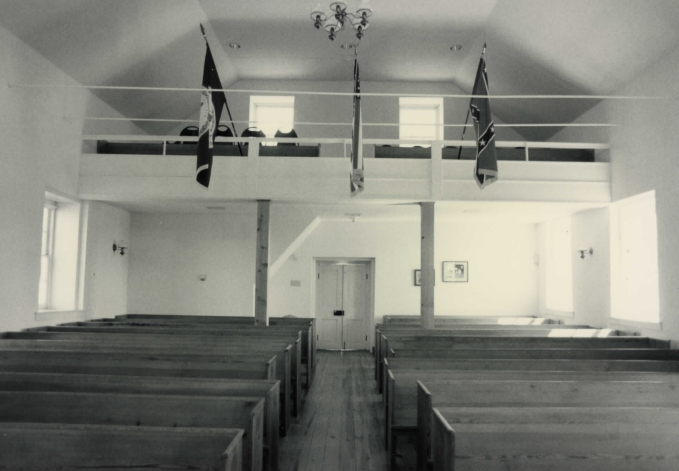
A 1973 interior photograph of the church, in the archives of the Department of Historic Resources, shows the ghost of a former upper gallery on the west wall of the church along with the ghost of an access stair rising from the northwest corner. In that photograph some cracking of the plaster is visible where a center window opening would have been and where the door providing gallery access would have been, corresponding with the scars still visible in the exterior stonework. The evidence of these earlier openings is no longer visible because the original plaster has been removed.
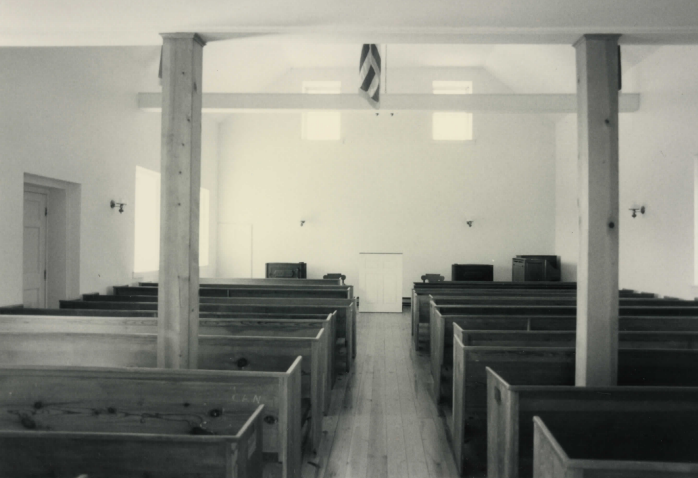
An architectural survey report from the early 1970s on file at the Department of Historic Resources suggests one or two theories about the upper gallery. The surveyor speculated that either there were once galleries at either end of the room and the one on the west end was removed, or, that the gallery was originally at the west end of the room and was moved to the east end.
The minutes for the church on file in the Virginia State Library and Archives cover the period 1804 to 1896, but include only a few scattered references to the church building itself and offer nothing conclusive about the gallery. The minutes show that a proposal to erect a gallery was rejected in 1804 in favor of finishing the meeting house “on the plan it was begun.” In January of 1805 the membership voted that the “meeting house should be left in a frame, that a gallery hereafter might be erected.” The records do not, however, provide clues as to when that gallery was erected, where it was placed or whether it was later moved. A fire in the northwest corner of the church may have been the reason for the removal or relocation of the western gallery. The evidence of the fire was uncovered during the restoration work at the church in the 1970s.
The meeting space is devoid of decoration. A plain wooden lectern, painted white, stands at the head of the central, uncarpeted aisle. The lectern is not original to the church but was made and donated for the restoration. Straight-backed wooden pews from a church in Bloomfield are arranged on either side of the aisle. A pair of simple wooden armchairs and a pair of cast-iron stoves once used for heating, but now without their stove pipes, are the only other pieces of furniture in the room. Lighting is supplied through modern recessed light fixtures and wall lamps and ceiling fixtures in a “colonial” style.
It is estimated that worship services were no longer being held in the Old Church by the early 1900s. In 1934 the church was acquired by the Ebenezer Cemetery Company, Inc., and since the early 1970s substantial restoration work on the Old Church has been carried out by that organization. The existing metal roof, hardwood floors and plastered sheetrock walls and ceiling are the products of these restoration efforts.
The New Ebenezer Church
The Greek Revival-style New Ebenezer Church is a one-story stuccoed stone building covered by a standing-seam metal gable roof. The church is 40.25 feet wide by 45.25 feet long; it is two bays wide and three bays deep. The dominant feature of the building is the vernacular, tetrastyle, steeply-pitched, pedimented portico with paneled frieze on the south side, or front, of the building. Its four columns are unfluted, with narrow Doric-type capitals, and no bases. The tympanum is weatherboarded. Two small stuccoed chimneys for heating stoves are located on both the east and west sides of the roof.
The floor and steps of the portico are of concrete. A survey report from the 1970s on file at the Department of Historic Resources states that the floor of the portico was wooden until the 1930s. A simple iron pipe railing, also a 20th-century alteration, surrounds the portico.
There are three tall, rectangular windows regularly spaced on both the east and west sides of the building. These twenty-over-twenty sash, double-hung windows are recent replacements, but they match the form of the originals. Access to a semi-excavated basement is made by three half-height door openings, one on the east side near the southeast comer and two on the west side near the southwest comer of the building. These doors permit a view of the building’s rough hewn beams some of which are still covered with bark.
There are no openings in the north gable end of the building. The tympanum is weatherboarded matching the front of the building.
Two Greek Revival-style paneled doors are symmetrically positioned on the front of the building. In front of each door is a small concrete step and a deep wooden sill. The door reveals are paneled. Two six-over-six sash, double-hung windows are placed directly over the entrance doors and provide light for the upper gallery.
The entrance doors lead into a vestibule that is about 12 feet deep and extends the entire width of the front of the building. Access to the upper gallery is provided by an enclosed winding stair in the southwest comer of the vestibule. Paneled interior doors topped by three-light transoms are directly opposite the entrance doors and provide access to the sanctuary.

The sanctuary is one large room with a tongue-and-groove board ceiling painted a soft blue-green and plastered walls painted a pale blue-grey. Two carpeted side aisles lead from the interior doors to a dais at the front of the church. The carpeting covering the aisles and the dais is a neutral grey. Facing the front of the church are eight rows of simple wooden pews, arranged between the two aisles and along the sides of the church.
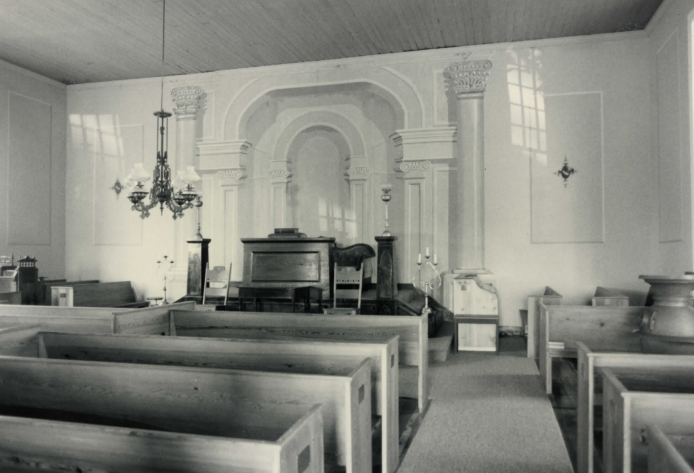
The lectern is set on a platform raised three steps from the dais. A set of carpeted steps leads to the platform from both the right and left sides of the dais. The platform is painted to look as if it is paneled. On either side of the lectern is a slightly tapered wooden pier holding a tall brass gas lamp with an etched glass globe and a shorter pier holding a simple brass candelabra. The fronts and sides of the piers are painted to resemble carved panels, some of which are in the shape of a Gothic arch.
A pair of straight wooden chairs and a simple table sit on the dais in front of the lectern platform. Behind the lectern is an upholstered Victorian-style sofa. Three straight wooden benches are arranged in both the northeast and northwest comers of the church facing the dais. An electric organ sits in front of the steps to the right of the pulpit; an old-fashioned pump organ to the left of the pulpit faces the back of the church. Two cast-iron stoves once used for heating, but now without their stove pipes, are found on either side of the church between the first and second windows at the head of the ranks of pews. On either side of the church a pew with its back to the lectern faces each stove and the forward-facing pew on the other side of the stove. A flat bench along the wall on either side of the church connects the facing pews and forms a C-shaped seating arrangement around each stove.
The upper gallery runs the width of the building at the south end of the room. Two square wooden columns support the gallery from the floor. A gaslight wall lamp with glass globe hangs on each of the columns. The face of the gallery is composed of horizontal wooden panels decorated with carving in a Greek key motif. The panels are painted white. The top rail of the gallery and the rail on which the panels rest, as well as the divisions between each panel, are painted a mocha brown. In the gallery are several rows of straight-backed wooden pews; the wooden floor is not carpeted.
Behind the lectern and filling the space from floor to ceiling on the north wall of the church is a trompe I’oeil painting that gives the impression of an apse beyond the lectern. The painting, which is not signed, is attributed to American artist Lucien Whiting Powell, who lived and worked in the area during the late nineteenth and early twentieth centuries. In varying shades of cream, brown, and grey to suggest light and shadow, the painting shows monumental Corinthian columns rising from large paneled base blocks flanking an arch resting on an entablature supported by square paneled pillars with Ionic capitals. Centered beneath the large arch is a smaller–and seemingly recessed–round-arched opening flanked by square paneled pillars with Ionic capitals.
The walls on either side of the painting are painted to resemble recessed panels in a beige color containing a central shield-like motif. The same beige panels, but slightly taller and without the central motif, are found between the windows on the east and west walls of the church. An intricate cast-metal gas light fixture hangs from a painted medallion in the center of the ceiling. Painted in colors similar to the painting behind the lectern, the medallion is shaded to give a three-dimensional effect. Related painted decoration in a triangular shape is found in the northeast and northwest comers of the ceiling. It is not known if the painted panels, ceiling medallion and corner decorations are also Powell’s work.
Between the first and second windows on either side of the sanctuary are cast-metal gas wall lamps with decorative glass globes. Simple pull-down shades are hung at each window. While the building has electric outlets, there are no electric lights and there is no central heat. It is believed that by 1941 worship services were no longer being held in the New Church. The Ebenezer Cemetery Company, Inc., which had acquired the New Church by 1959, replaced the roof, repaired the stucco, and replaced the windows during the 1970s and early 1980s. Just behind and slightly to the east of the New Church is a non-contributing storage building. It is a frame structure covered with corrugated metal with a metal gable roof.
The Cemeteries
To the west and north of the Ebenezer churches are the Old Cemetery and the New Cemetery, respectively. Both cemeteries are surrounded by handsome walls constructed of native field stone. The cemeteries are well maintained and provide an appropriate setting for the Ebenezer Baptist Churches. Between the two churches is one entrance to the cemeteries. On either side of the entrance is a set of two stone pillars, one between 4 and 5 feet tall, the other 12 to 18 inches shorter. Between the taller and the shorter pillar on the west side of the entrance is a short section of wooden picket fence. That between the pillars on the east side is now missing, but is visible in earlier photographs. Also visible in earlier photographs, but no longer in place, is a set of picket gates between the larger pillars. Another set of stone pillars frames a second entrance to the cemetery just to the east of the New Church.
The wall surrounding the old cemetery probably was erected after 1804, when the will of John Butcher, oldest son of Samuel Butcher, Sr., gave the use of his plantation, upon the death of his wife to “the church formerly caller Butcher’s meeting house, but now called Ebenezer” to be rented out with 100 pounds of the rent money to be put toward a wall to enclose the cemetery.
The old cemetery contains about 235 gravestones. The oldest marker appears to date from ca. 1800; the most recent is dated 1905. Most of the stones are simple markers with rounded or scalloped tops. Many of the stones in the cemetery date from the 1840s, ’50s and ’60s.
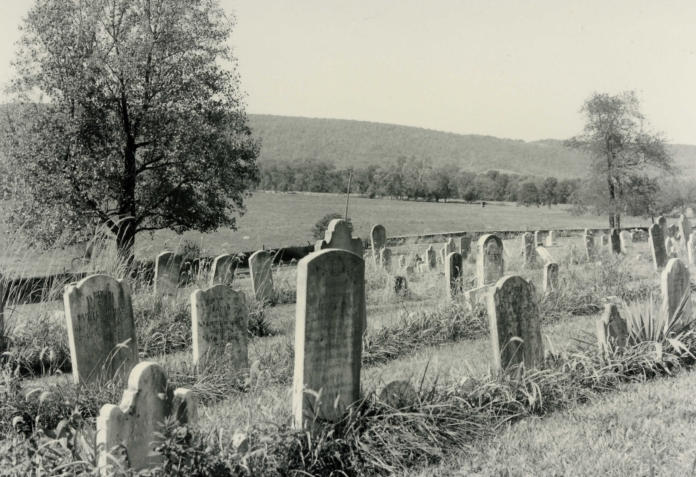
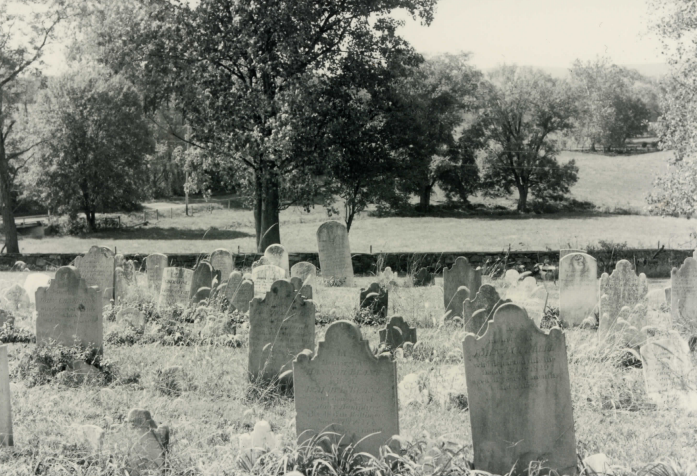
The Ebenezer Cemetery Company, Inc., which cares for the churches and the cemeteries, has prepared a listing of the inscriptions on the gravestones in the old cemetery. One of the markers is for the grave of Elder Charles Polkinhorn, a minister of the Old School Baptist order. The cemetery also contains the grave of a Civil War soldier who died from wounds received at the Battie of Ball’s Bluff in October of 1861.
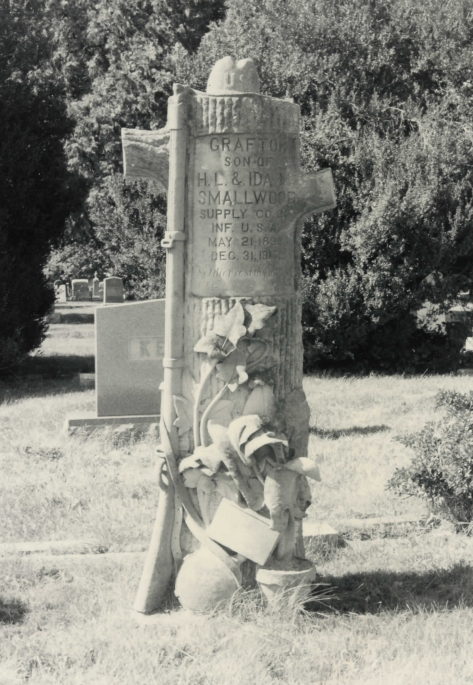
The Ebenezer Cemetery Company was incorporated on April 29, 1887. Land for the new cemetery was deeded to the Ebenezer Cemetery Company in 1888 and the first burial there occurred in that year. The new cemetery has been in continuous use since 1888, with additional land being acquired as needed. The new cemetery contains about 1700 graves marked by a variety of older style and more modern gravestones and obelisks with dates ranging from 1888 until the present. At least one of the stones is a five-foot monument styled to resemble a tree trunk. Marking the grave of Henry G. Smallwood (died in 1918), it is topped with a World War I Army infantryman’s hat; a rifle leans against the tree trunk and a canteen rests at the base along with a flower pot holding vegetation that climbs up the “tree”. The cemetery contains the graves of two other World War I soldiers, the grave of a Spanish American War soldier and the graves of about 30 Confederate veterans who were buried there between 1897 and 1929.
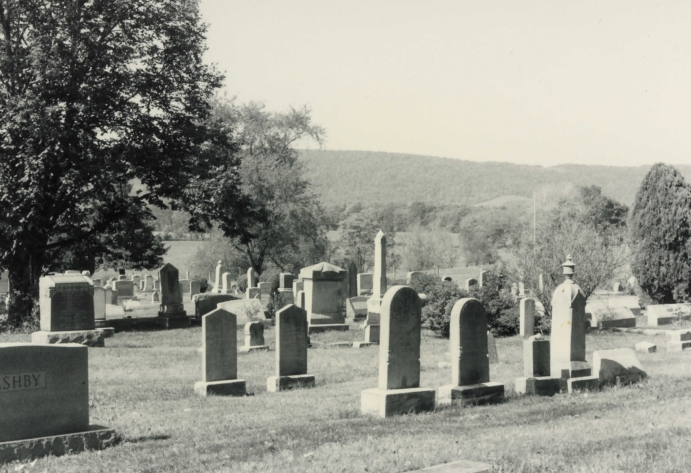
The Ebenezer Cemetery Company has prepared an index of the pre-1940 graves in the new cemetery. Organized by date of death, plot number, and surname, the index is a useful research tool.
The Old Ebenezer Church was transferred to the Ebenezer Cemetery Company in 1934, there being no congregation using the church by that time. In 1941, the Cemetery Company’s charter was revoked for nonpayment of taxes during the previous two years and it is assumed that by that date there was no longer any congregation using the New Ebenezer Church.
The Ebenezer Cemetery Company was re-incorporated in December 1959 to care for the two cemeteries and both of the churches. Since that time the Ebenezer Cemetery Company has carried out restoration work on both of the churches as well as on the walls surrounding the cemeteries. Work continues to be done as funds are available.
STATEMENT OF SIGNIFICANCE
The two buildings known as the Ebenezer Baptist Churches are located side by side in a well preserved rural area of Loudoun County near the town of Bloomfield. The Old Ebenezer Baptist Church is a vernacular stone building that may have been built before 1769 and was used by both Old School and New School Baptist congregations until ca. 1855; the New Ebenezer Baptist Church is a stucco-covered stone building constructed ca. 1855 in the Greek Revival style for the New School Baptist congregation at Ebenezer. Behind the lectern in the New Church is a trompe I’oeil painting executed by Lucien W. Powell, a nationally known artist who had a home and studio in the area. A rare type of painting, it is Powell’s best surviving work in the county. The churches are significant, individually, for their architecture and when considered together they form one of the best-preserved pairs of Baptist churches in Virginia. The surrounding cemeteries with their handsome stone walls provide an appropriate setting for the churches and contain an interesting collection of gravestones dating from the early 19th century to the present day. The older cemetery contains about 235 stones with dates ranging from ca. 1800 to 1905; the newer cemetery contains more than 1700 gravestones with dates ranging from 1888 to the present, including the graves of 30 Confederate veterans who were buried there between 1897 and 1929.
HISTORICAL BACKGROUND
The Old Ebenezer Church
The Old Ebenezer Church, earlier referred to as Butcher’s Meeting House or the Ebenezer Meeting House, may have been built before 1769 on land owned by Samuel Butcher, Sr. His ill of September 12, 1769, gives two acres of his land for the use of “the Baptist Meeting House and School House,” describing those two acres as “the same that the Meeting House is now built upon.”3 It was not until April 1804, however, that the Ebenezer Church was constituted when nine members of the Goose Creek Baptist Church and eight from Ketoctin Baptist Church were dismissed from their congregations for the sole purpose of constituting a new congregation.4
It is not known whether or not the founding members of the Ebenezer Church met in the old stone church building that stands today. In November and December 1804, again in October 1805, and even as late as January 1806 the minutes of the church business meetings discuss “finishing the Meeting House.”5 It is possible that the building alluded to in the will of Samuel Butcher, Sr., was, therefore, no longer standing by 1804 when the Ebenezer Church was constituted.
The 1804 will of Samuel Butcher’s son John provided for the Ebenezer Meeting House in several ways. First, he gave the church the use of his plantation to be rented out at his wife’s death, with one hundred pounds to be put towards building a wall around the cemetery. John Butcher also willed his “Negro Daniel to be rented out or hired until he earns one hundred pounds … to [be] put to the use of said meeting house . . . and then I will Negro Daniel to be set free.” Finally, the will identified 60 pounds to be applied to a free school at Butcher’s Meeting House. No further information on a school at the meeting house, other than the two references in Butcher family wills, has been found.6
The whole of the senior Samuel Butcher’s holdings passed from his wife, Susanna, to his son, Samuel Butcher, Jr., when he reached age 21. It was Samuel Butcher, Jr., who by indenture dated January 16, 1834, deeded those same two acres “on which the house called the Ebenezer Meeting house now stands” to two trustees of the Ebenezer Meeting House “as a place of worship for the Baptist Society in the neighborhood.”7
Beginning in the 1830s differences in philosophy began to divide many Baptist congregations in the State. Church leaders and members were divided in thought concerning the appropriateness of Sunday schools, music in the worship service, reform and missionary movements, and Bible societies. Congregations accepting these new ideas and practices and favoring more independence of members were referred to as “New School Baptists”; those rejecting them were referred to as “Old School” or “Primitive” Baptists because they adhered only to what they believed to be the practices of the primitive church, or the church as described in the Bible.
The church minutes for Ebenezer reflected this growing controversy beginning in 1833 when eight members of the congregation requested dismissal from the church, charging the membership with not acting independently in the choice of a pastor and to being “blindly led by the influence of priestcraft.” This “minority” was excluded from the fellowship of the church and apparently formed a separate congregation. The group dismissed from Ebenezer aligned themselves with the New School Baptists; the remainder considered themselves Old School Baptists. In December of 1833 the church minutes indicate that one of the excluded members had applied to a pastor to preach for them at “this place” (Ebenezer). Subsequent entries in the minutes describe the need to meet with counsel concerning the meeting house and land.8
These events explain the language used by Samuel Butcher, Jr. in January 1834 when he deeded the meeting house property to the Trustees of the Ebenezer Meeting House. The indenture includes the following guidance:
“inasmuch as difference of sentiment amongst the Baptists, have arisen, . . . which ought not to be the cause of separation between Brethren, it is not intended that one party so differing in sentiment shall use and enjoy the property herein conveyed to the exclusion of the other party, but the said Trustees are . . . hereby authorized … to permit any party of Baptists whom they . . . consider of good order and good Standing in the society, to use and enjoy the said property for the purpose of Worship, provided that no party shall have the exclusive privilege of the house more than two Lords days in the Month.”9
Apparently, both Old School and New School Baptist congregations used the Ebenezer meeting house until about 1855. Samuel Trott was pastor of the Old Ebenezer Church for close to thirty years from 1835 until his death in 1865. Trott was a leader of the Old School Baptists and had been preaching frequently at Ebenezer when the division in the membership occurred. He accepted a call to serve as pastor for the Old School congregation at Ebenezer in 1835, with the understanding that if he should prove to be the only reason for a division among the congregation then he would leave.10
In July of 1855 the minutes report “In the providence of God our meeting house being burned we proceeded to … appoint trustees … to prepare subscriptions and present to the Brethren and friends in order to rebuild.” No further information is given concerning the extent of the fire damage or the amount collected to rebuild. There are no further notes in the minutes concerning progress on the rebuilding or of worship service resuming in the rebuilt church,11 When restoration work was carried out on the Old Church in the 1970s, evidence of the fire was discovered under the old floor in the northwest comer of the building. Most of the floor joists showed no serious damage from the fire. It is possible that damage from this fire was the reason for the relocation or removal of the upper gallery formerly at the west end of the meeting space.
Apparently, the burning of the meetinghouse encouraged the New School Baptists to find a home of their own. In September 1855 William Galleher and his wife deeded three-quarters of an acre of land to trustees for the Ebenezer Church, identified in the deed as “(New School Baptist) who were accustomed to worship in the Old Ebenezer Church previous to the late burning of the same.” The land being deeded is described as “lying immediately adjoining the lot on which stood the old Baptist Meeting house called Ebenezer.”12
Tradition has it that it was at the Old Ebenezer Church that Confederate Colonel John Singleton Mosby and his men divided the Federal payroll captured during his Greenback Raid in 1864. According to historians, this raid was but one episode during two weeks in October 1864 in Mosby’s “war” for the Manassas Gap Railroad after it was seized by Federal authorities. On the evening of October 13, 1864, Mosby and his Rangers attacked a west bound train at an unguarded gap in the Baltimore and Ohio Railroad at Duffield’s Station, west of Harpers Ferry. The federal payroll on the train was seized by the Rangers and the passengers gave up their valuables. Historian Jeffrey Wert notes that the following day “at Ebenezer Church in Bloomfield” the stolen payroll was divided among the eighty or so Rangers participating in the raid.13 While it apparently cannot be documented, the story is well known and deeply rooted in the area. A local Civil War historian, John Divine, notes that Ebenezer Church would have been on the route of withdrawal from the Greenback Raid and could well have been the secluded spot where the spoils were divided.
Whether or not Col. Mosby’s exploits included Ebenezer Church directly, this area of Loudoun County suffered from continued military activity during the years of the Civil War. There are no minutes for the church business meetings between September 1861 and July 1865. A note follows the latter entry and states that the “church has not met together for upwards of three years and the cause thereof was the war … the armies of both sides being in the neighborhood and our Pastor being a prisoner nearly the whole of the above time.”‘14 Sympathizers with the Southern cause were frequently imprisoned by Federal troops in an effort to drain support from operators like Mosby.
Following the Civil War, Robert C. Leachman, Joseph L. Pennington, and J. N. Badger, in succession, served as pastors of the Old Church. In 1869 the minutes indicate that a committee was appointed to find out the cause of the “colored members of this church absenting themselves from among us.” Like most Baptist churches, from its constitution in 1804 Ebenezer’s membership had been both black and white, with all men and women being received in the same way, either by baptism or upon submission of a letter from another church. As late as 1888 the minutes show that “colored” members were still being accepted.15
The minutes for the Old School Baptist Church at Ebenezer cover the period from 1804 to 1896. Members of the Ebenezer Cemetery Company who now care for the church estimate that services were discontinued at the Old Church around the turn of the century. It was 1934 when the Cemetery Company took title to the Old Church and became responsible for its upkeep.
The New Ebenezer Church
The New Ebenezer Church was built on three-quarters of an acre of land deeded by William Galleher and his wife to trustees for the Ebenezer Church (New School Baptist) in September 1855. The exact date of construction is not known but the building’s Greek Revival style suggests a date not much later than 1855. No minutes of business meetings for this congregation have been found. It appears likely that the New Church was constituted soon after 1833 when eight members were dismissed from the Old Ebenezer Church after expressing their philosophical differences with the majority of the congregation. Until 1855 the New School Baptist congregation of the Ebenezer church apparently met in the Old Church.
The interior of the New Church presents a striking contrast to the austere interior of the Old Church and emphasizes one of the differences between Old School and New School Baptist churches. The interior of the New Church is marked by use of color and decoration. The dominating feature of the interior of the New Ebenezer Church is the tromp I’oeil painting behind the lectern that suggests an apse beyond. Painted in varying hues of cream, brown and grey, the work is attributed to American landscape and historical painter Lucien Whiting Powell, who had a second home and studio just up the road at Airmont between 1876 and his death in 1930. The painting was not signed by Powell, but the artist and his work in the community are well remembered by some of its older residents.
Powell was born in Loudoun County at Levinworth Manor in 1846. He enlisted in the Confederate army at age seventeen and studied art in Philadelphia and Europe after the Civil War. Powell’s paintings were very popular; his work was admired by presidents Theodore Roosevelt and Franklin D. Roosevelt and by J. Edgar Hoover. His paintings can be found in the U.S. Capitol, in the National Gallery and the Corcoran Gallery in Washington, D.C. Powell is best known for his paintings of the Grand Canyon and his views of Venice.16
It is not known when Powell made the painting at the New Ebenezer Church. While a resident of Washington, D.C, Powell bought property in 1876 at Airmont next door to his birthplace, so it is likely that the painting at the New Ebenezer Church was made sometime after that. Powell was appointed postmaster of Airmont by President McKinley in 1897 and is credited with naming the village for its abundance of fresh air and mountain views. A small two-room building that still stands at Airmont at the intersection of routes 719 and 734, just a little over a mile from the Ebenezer churches, is said to have been Powell’s studio. That studio stands just across the street from the site of the Airmont post office. Another trompe I’oeil painting by Powell can be found in the Ketoctin Baptist Church, near Round Hill in Loudoun County.
Powell’s career was influenced by the friendship and patronage of Mrs. John B. Henderson, the wife of a senator from Missouri. She established a studio for him at her home in Washington, D.C. and supported him for many years. Powell was buried in Arlington National Cemetery in 1930 but was disinterred and reburied in Congressional Cemetery in Washington two years later.17
In 1974, the Powell painting at the New Ebenezer Church was repaired and repainted by Frank Millot, a commercial artist from Rochester, N.Y., and a grandson of Powell. A newspaper article from 1974 in the archives of the Department of Historic Resources explains that Millot carefully scraped the plaster walls, prepared them for repainting, and matched the colors of the original work, darkening the hues slightly to compensate for decades of fading. Millot comments in the article that Powell and his wife, the former Nora Fitzhugh, were married at Ebenezer Church in 1880.18
It is thought that by 1941 the New Church was no longer in regular use. By 1959 the church had been acquired by the Ebenezer Cemetery Company, Inc. Today, both the Old Church and the New Church and the two cemeteries on the site are owned and maintained by the non-denominational Ebenezer Cemetery Company, Inc. The churches are used for services several times a year, as well as for weddings and other special occasions.
MAJOR BIOBLIOGRAPHICAL REFERENCES
- Clark, Jewell T., and Elizabeth Terry Long, compilers. A Guide to Church Records in the Archives Branch
- Virginia State Library and Archives. Richmond, Virginia: 1988.
- Department of Historic Resources archives.
- Divine, John. Personal correspondence. 1993.
- Fielding, Mantle. American Painters. Sculptors, and Engravers.
- Loudoun County Will Books and Deed Books.
- Mallett. Index of Artists.
- Minutes of Ebenezer Baptist Church, Loudoun County 1804-1904. Miscellaneous microfilm reel 225. Virginia State
- Library and Archives.
- Dictionary of American Biography.
- Ryland, Granett. The Baptists of Virginia 1699-1926. Richmond, Virginia: 1955.
- Wert, Jeffrey. Mosby’s Raiders. 1992.
- Who Was Who in American Art.
- Wright, R. Lewis. Artists in Virginia before 1900.
- Who’s Who in America. 1930.
- Meserve, Stevan F.; Morgan III, James A.. The Civil War in Loudoun County, Virginia: A History of Hard Times (Civil War Series) pp. 91-92 ↩︎
- The Memoirs of Colonel John S. Mosby pp. 179-178 ↩︎
- Loudoun County Will Books. Will of Samuel Butcher dated September 12, 1769. ↩︎
- Minutes of the Ebenezer Baptist Church. Miscellaneous microfilm reel 226. Virginia State Library and Archives. ↩︎
- Minutes of Ebenezer Baptist Church. ↩︎
- Loudoun County Will Books. Will of John Butcher. September 1804. ↩︎
- Loudoun County Deed Books. Indenture from Samuel Butcher, Jr. to Trustees of Ebenezer Baptist Church dated January 1834. ↩︎
- Minutes of Ebenezer Baptist Church ↩︎
- Samuel Butcher, Jr. Indenture. ↩︎
- Minutes of Ebenezer Old School Baptist Church ↩︎
- Minutes Ebenezer Baptist Church ↩︎
- Loudoun County Deed Books. William Galleher to New School Baptist Church at Ebenezer. September 1855. ↩︎
- Jeffry Wert. Mosby’s Rangers. ↩︎
- Minutes Ebenezer Baptist Church. ↩︎
- Minutes Old School Ebenezer Baptist Church. ↩︎
- Eugene Scheel. “Airmont: Home of a Famous Painter”. Loudoun Times-Mirror. 1976. Copy in archives of Virginia Department of Historic Resources. ↩︎
- Dictionary of American Biography. ↩︎
- Karen Timmons. “Keeping the Faith at Ebenezer Church”. Metro Virginia News. July 7, 1974. Copy in the archives of the Virginia Department of Historic Resources. ↩︎
 Mairi & Dave's Gallivant Through Virginia and About