Vauter’s Episcopal Church
“Upper Church of St. Anne’s Parrish”
Loretto, Essex County, Virginia
Awhile back Mairi and I had purchased a book called Historic Virginia Homes and Churches by Robert Alexander Lancaster. The book was a photocopied rendering of the original which was published in October of 1915. The preface notes that “in 1888 the writer began to gather photographs of historic buildings in Virginia for his private collection, and later, upon the request of friends, decided to publish them”. It was in reviewing the chapter on “THE RAPPAHANNOC AND POTOMAC” that we happened on Vauter’s Church and were immediately drawn to taking the following Gallivant. The excerpt from this book is the first one cited.
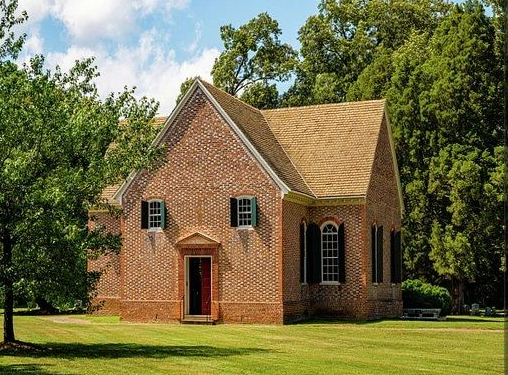
VAUTER’S CHURCH
From “Historic Virginia Homes and Churches” by Robert Alexander Lancaster, Jr., Published October 1915 by J.B. Lipponcott Company
Vauter’s Church, St. Anne’s Parish, Essex County, takes its name from the family on or near whose land it was built. A brick in its south wall bearing the date 1731 had led to a belief that it was erected during that year, but it is likely the figures have reference to the year of some addition or repair, as there are abundant evidences of greater age. In an article published in the SOUTHERN CHURCHMAN, February 2, 1907, P. S. Hunter, a member of the parish, gives the following interesting word-picture of this old church:

“Of all the magnificent river view in the Tidewater Virginia, few excel that from the summit of Chimborazo Hill in upper Essex County. Commanding on one side the long, beautiful stretches of the beautiful Rappahannock, flowing through its fertile plains, it displays on the other, thickly-wooded uplands in ascending terraces of richly blended verdure. But the most prominent object in the foreground is old Vauter’s Church, standing in its ancient grove of oak and walnut. It is approached by the ‘Church Lane’ considerably elevated above the fields on either side, from the accumulation of soil washing down from the hills, and is bordered by dense hedges of growth so characteristic of the country, and in the Spring so exquisitely fragrant with the blook of wild grape and eglantine.
“The church is a brick building of cruciform shape, with its three high sharp gables supporting a shingle roof cut close to the edge of the wall. Its high and narrow windows are guarded by heavy, solid wooden shutters.
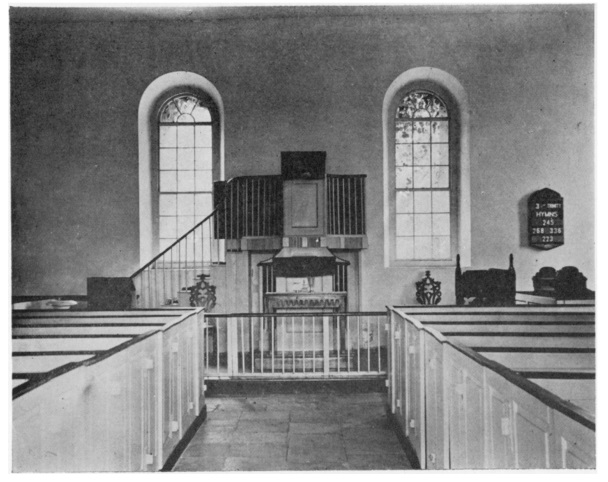
“The present chancel raised one step from the stone-paved aisles is furnished now with two modern stands or lecterns, for the service and sermon, but back against the wall there still stands the old reading desk and pulpit above it…The pews are the same old box stalls with benches of uncompromisingly rigidity, and furnished with clanging doors which announce the retirement of the occupants; but they have been cut down to nearly half of their former height. Formerly pews and pulpit were so high that both the minister and the congregation could enjoy deep seclusion…To complete the description of the venerable building there is only to be added that its walls are covered by the most luxuriant mantle of English ivy.”

The Colonial Churches of Essex and Richmond Counties
Author: George Carrington Mason
Source: The Virginia Magazine of History and Biography , Jan., 1945, Vol. 53, No. 1
(Jan., 1945), pp. 3-20
Published by: Virginia Historical Society
A first Upper Church for St. Anne’s Parish appears to have been built at an unknown date and location, before the erection of the existing Vauter’s Church as the last Upper Church of this parish, during the second decade of the eighteenth century. The existence of the earlier church is established by a county court order of 21st November, 1738, recording that Cornelius Noell had been “presented for not keeping the road in repair . . . from the Uper ould Church in St Anns Parish to Jones’ Mill whereof he is appointed Sirveyor”, since the term “ould” is clearly intended to distinguish the church mentioned from the newer church then in service.
This first Upper Church of St. Anne’s Parish is also mentioned in a court order of 1711, “that John Boughan be Surveyor of the highways in the precinct where Nicholas Copland was Surveyor and that he clear a road from Smith’s Mill to the Upper Church of S……….Pish”. In this record, the page has been mutilated so that only the initial of the parish name remains, but an order of 10th September 1706, shows that Copland was highway surveyor for the middle precincts of St. Anne’s Parish.
The erection of Vauter’s Church, about the year 1719, is attested by a county court order of 9th May in that year, appointing Thomas Ramsay as “overseer of the road from Jones’ Mill up to the upper Church in St. Ann’s pish (parish)” and requiring this road to be cleared, as was usually done to provide access to a new church, recently completed. The fact that both churches could be reached by roads from the same mill suggests that their sites were not far apart. The present building stands near the head of Blackburn’s Creek, in a grove of old trees on the east side of U. S. Route 17, about 3 1/2 miles south of the Caroline County line and 18 miles north of Tappahannock.
The identity of the building involved in the order last quoted, as the present church rather than its predecessor, is proved by a plot surveyed by John Vauter in 1719 for John Hawkins’ land on Blackburn’s Creek, showing as a boundary “the church land”. There is also a deed of 17th July, 1721, from Buckingham Browne of St. Anne’s Parish to Richard Long for 297 acres at the head of Blackburn’s Creek, “near a path that leadeth from the Church to Job Spearmans called Spearmans Church path” and adjoining “John Vawters land which he bought of Browne” and also near John Hawkins’ grant. A land survey made by Vauter for Browne in 1722 shows this “Church path” as “the road leading to the Church”.
Vauter’s Church was originally a rectangular building, fifty-two feet seven inches long by twenty-six feet three inches wide, inside, in accordance with the standard proportions of a colonial church, whose length was usually twice its breadth. The building was oriented, so that its long axis lay east and west, as required by English ecclesiastical law.
The original church structure was enlarged in 1731 by addition of a south wing, sixteen feet long and the same width as the rest of the building. This addition was placed three feet off center of the south wall of the church, toward the east end, and its date of construction is inscribed on a brick tile set into the wing’s end wall, above the right side of the south entrance doorway. The church walls are two feet thick throughout, above the high foundation, and are laid in Flemish bond with glazed headers.
As first erected, the church had the conventional arrangement of doorways, with the main entrance at the west end and a secondary entrance in the south wall near the chancel. There were two windows in the east end and four in the north wall, all of which still remain, but none was fitted in either gable of the building. Of the three windows in the south wall, one was eliminated by the addition of the wing, only the two end ones being left. The south entrance was transferred to the wing’s end wall, in whose gable two small windows were provided to light the south gallery. There is one window in each side of the wing.
Vauter’s Church is one of the earliest Virginia colonial churches known to have been fitted with the classic pedimented doorways typical of eighteenth-century churches in this colony. Both of its doorways are fine examples of their kind and in strict accord with the design practically standardized in later Virginia buildings. These doorways have been illustrated by measured drawings in a previous publication by the author. The church is unusual in that it appears to have retained its original wood doors, sash windows and shutters, with most of their original hand-wrought hardware.
Like many others of our colonial church buildings, Vauter’s Church passed out of service during the decade following the Revolutionary War. Bishop Meade quotes Mr. Richard Baylor, of the neighboring plantation of Kinlock, as stating that the old church was saved from the destruction visited on all other colonial churches in the county, by the friendship of Mrs. Muscoe Garnett of nearby Elmwood. Upon hearing that the aisle flagstones, bricks and other materials of the church were being taken away, Mrs. Garnett claimed the building, as standing on her family lands, and threatened to prosecute the next offender. Mr. Baylor also relates that the church’s old English Bible was kept at Marl Bank, his father’s home, during the period of abandonment. He draws a vivid word-picture of its being carried to and from the church on the head of a negro servant, who accompanied the family over “a near walking way” across the creek, to attend the occasional service by a passing Episcopal minister.
Following the resumption of regular services in 1822, the interior of the church was repaired and somewhat modernized in 1827, under the rectorship of Reverend John P. McGuire, and through his influence, the old colonial pulpit was replaced by a new one of a type popularized by Bishop John Henry Hobart (1775-1830) of the New York diocese. The old box pews were reduced in height and the chancel was removed from the east end of the church and placed in the middle of its north wall. Here, against this wall, was built the new high pulpit, reached by a railed stairway leading up from the west end of the chancel. In front of this pulpit was placed the communion table, an arrangement completely foreign to colonial usage, which never placed the pulpit within the chancel. The original south and west galleries remain, but a vesting room was partitioned off under the west gallery, at the church’s remodeling.
The following excerpt is taken from the Home of the FAMILY ASSOCIATION VawterFamily.org
The Vauter’s Church of St. Anne’s Parish, Essex County, Virginia In Essex County Virginia, there still stands the original Vauter’s Church. John Vawter, son of Bartholomew, was a vestry man and supporter of Vauter’s. As the typical Virginia plantation house of the eighteenth century sat in the midst of broad acres of plowed field, pasture, and woodland, remote from neighbors, so the typical Virginia church of that century was the crossroads church, set by itself in a field or a wood, at a point convenient to a group of plantations that covered a great stretch of country. The land of the church was near the land that Bartholomew Vawter inherited from his wife’s father, William Hodgson. In 1699, Bartholomew purchased land of John Hawkins which also abutted the church grounds. The path to the church was called “Spearman’s Church Path” and abutted the property of Job Spearman. It may be that John’s brother Edward Vawter was involved with the actual construction of the brick church in ca 1731. There were also several churches before and after Bartholomew Vawter located in the south and north parts of St. Anne’s parish.
It was first believed that the original section of the church was built in 1719 and an addition added in 1731, but in 1969 the church was stripped to its original brick for renovation and found that the entire church was built at the same time. A brick over the door is inscribed 1731. The church was rarely referred to by Vauter’s Church but by its original name the “Upper Church of St. Anne’s Parrish”

Rev. Ralph Fall minister of Vauter’s from 1962-82 was an avid researcher and historian of the church and discovered that in 1704 the first minister was Parson James Smith. Rev. John Bagge came from Ireland to the parish about 1709, in 1716 Bagge returned from England. In 1717 the vestry men of VA had the authority to appoint the clergy and appointed Rev. Giles Rainsford but he left for Maryland so Bagge stayed on. The Rev. Robert Rose came in 1725 until 1748 when he went to Albemarle County. His diary covers the last years at St. Anne’s and the beginning of Albemarle ministry until his death in 1751. Ministers generally served both churches, preaching in the south church one week and the upper church the next.
The vestry was the governing body of each parish. It had 8 members who were chosen by the congregation, representing the geographic area of the parish bounds. No women were allowed to 2 serve until the 1900’s. Vestry men filled their own vacancies and elected officers consisting of two Wardens, a clerk, and treasurer. Vestries had five responsibilities:
- after 1716 to select the parish clergy
- investigate moral offenses, including absenteeism from service (a legal offense)
- to lay the parish levy or tax upon all white and black males over 16 years of age, which provided the funds “to build, repair, and adorn the Churches and Glebes”
- to care for the indigent and orphans
- to “process the bounds” (measure land boundary lines to determine levies and land titles).
When the General Assembly in the 1720s sought to manage tobacco production by limiting the number of seedlings that could be planted and tended, the parish vestries—not the county justices—were responsible for appointing and supervising inspectors. The county court in turn dealt with the violators. Subsequently, when the assembly moved to a warehouse system as a quality-control device for tobacco, responsibility for appointing and supervising inspectors was transferred to the county court justices. By law the justices appointed surveyors of the county roads while parish vestries assigned the “hands” to the surveyors for clearing and maintaining the roads. The failure of English authorities to provide bishops and diocesan administration for its Anglican colonies had among its several consequences the absence of ecclesiastical courts. Twice yearly the county grand juries, upon information offered largely but not exclusively by the parish churchwardens, brought presentments against violators of the laws defining moral offenses and requiring church attendance. “Blue Laws” were by no means peculiar to New England, nor were Virginians hesitant to enforce their own codes of behavior. Those found guilty as charged in Virginia paid fines that were turned over to the parishes to be used in assisting the poor.
Deciding to build a church, hiring a parson, appointing tobacco inspectors, or binding out an orphan were functions of the parish vestry, reflecting a sense of community united in its beliefs, values, and needs.
Vestries every four years divided their parishes into precincts and appointed for each precinct at least two “honest, intelligent” freeholders who, with whatever assistance they required, walked the boundary lines of the properties owned by precinct residents. In the presence of the landowners, the inspectors confirmed existing tree blazes and other boundary marks and established new ones if the old had been destroyed or moved. This quadrennial reaffirming of boundaries afforded occasions to resolve disputed lines to the mutual accommodation of the interested parties. The inspectors’ reports that were duly entered in the parish—not the county court—records represented the acknowledgment by all landowners that the boundaries were accurately marked. Recourse by suit through the county court was available to those unwilling to accept the determination of the boundaries by the processioners.
John Vawter was a vestry man in Essex County He would have voted to build a new church and help to fund the project. Much information is found on John surveying bounds and testifying in court and would confirm his importance. He also had a rolling road and warehouses built on his property which controlled the tobacco production. No information is found as to who assumed the vestry position after John was deceased.
The Vawter, Vauter, Vaughter(s) (VVV) Association reunions are held yearly throughout the United States and every 5 years are held at the Vauter’s Church location. The church is in the National Registry of Historic Places and is maintained as the eleventh oldest church still in active use in Virginia.
The following is excerpted from The Essex County Historical Society Bulletin Volume 4, May 1973
Four Essex County
Landmarks
By RALPH EMMETT FALL
Port Royal, Virginia
Of the many venerable structures erected in Essex County, four in upper Occupacia District have been placed on the Virginia Landmarks Register and the National Register of Historic Places:
VAUTERS CHURCH
Loretto, Virginia
St. Anne’s Parish was formed in 1704 from old Sittenbourne Parish. Its first lower churches had been located in the vicinity of Champlain (“Sales’s Church”), probably of frame construction, was built near the Rappahannock River on present Mount Pleasant farm above Loretto. In 1719, another upper church, rectangular in shape, replaced the earlier one, and twelve years later was itself increased in size with a sixteen-foot wing and bricked in as a unit in splendid Flemish bond with glazed headers.
The oyster-shell mortar is still in its original condition, and a date “1731” for the remodeling is etched in a brick over the south doorway. The architect’s name is unknown, but the bricks were fired probably on the site. Edward Vawter, one of three brothers who immigrated to Virginia in 1685, is described in his family’s records as “the builder of the church in 1731” which may mean that he superintended its construction. In early church records, his name became mis-spelled as “Vauter’s Church” and has so remained since.
The first Wardens of the parish were Edward Moseley and Benjamin Moseley, succeeded next by Thomas Ramsey and Francis Gouldman. James Smith was the first rector, and the present writer appears to be the 28th rector in 269 years. The two-story Glebe on present Cloverfield Farm, now owned by Mr. And Mrs. James Hundley, Jr., near Chance, Va., was also erected in about 1731, showing a style of brick-work similar to that of the church, and remains one of the oldest Glebes in Virginia. It replaced an earlier Glebe near the church, on land purchased from the Wardens by John Micou in 1706. The brick Glebe was sold in 1803 to Edward Rowzee whose servant, Frederick Robb recalled when men dressed in knee breeches and boot, and driving horses and coaches, attended Sales’s Church.
A roadway formerly surrounded Vauters Church, where the fashionably-dressed Colonial communicants alighted from similar carriages at the church door, and then the carriage wheels passing by often struck the church building, where the marks are still visible. The parish received a set of four pieces of English communion silver dated “1724” in its earlier days, two chalices and two patens. Three of these pieces became missing for over 100 years until 1909, when two of them were retrieved for $150 from an antique dealer in New York. One paten is still missing. The Rev. Robert Rose was rector of this parish from 1725-1748, during which time he kept a “Diary”. He listed the names of 90 persons baptized and 32 couples married by him in that period, most of whom belonged to the parish, indicating a thriving congregation. An event of unusual nature to occur in a churchyard took place in 1812, when James Bankhead and Colin Buckner, both of Port Royal nine miles distant, held a dual. But only one shot was fired, and both parties went home unscratched, attended by Robert Starke, surgeon of Norfolk.
At the turn of the 19th century, no services were held in the church. In 1827, the high box pews were cut down to their present size and re-arranged. All the woodwork, paneling and pews, hardware, two sets of double entrance-doors, many window panes, and aisle-flagstones (brought over as ship-ballast) are here originally from 1731 or earlier. In 1960, Vauters Church celebrated the 250th anniversary of the church building, and the 265th anniversary of the parish’s founding, and was modernized with electric heating and air-conditioning. With an active congregation today, its structure is the 11th oldest among 48 colonial churches still standing in Virginia.
Vol. 53, No. 1 (Jan., 1945), page 13
Published by: Virginia Historical Society
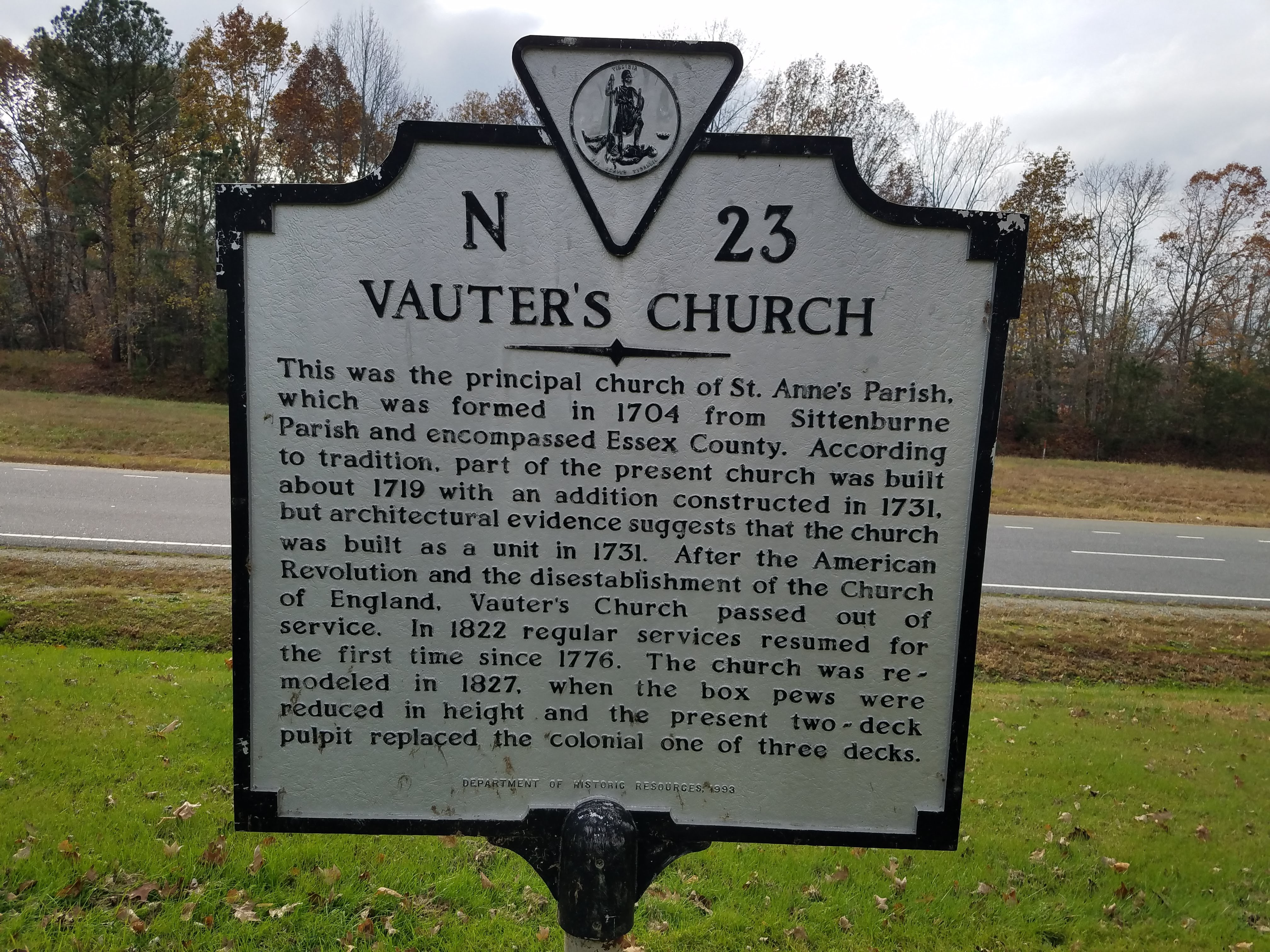
Vauter’s Church
N-23
This was the principal church of St. Anne’s Parish, which was formed in 1704 from Sittenburne Parish and encompassed Essex County. According to tradition, part of the present church was built about 1719 with an addition constructed in 1731, but architectural evidence suggests that the church was built as a unit in 1731. After the American Revolution and the disestablishment of the Church of England, Vauter’s Church passed out of service. In 1822 regular services resumed for the first time since 1776. The church was remodeled in 1827, when the box pews were reduced in height and the present two-deck pulpit replaced the colonial one of three decks.
Department of Historic Resources, 1993
 Mairi & Dave's Gallivant Through Virginia and About